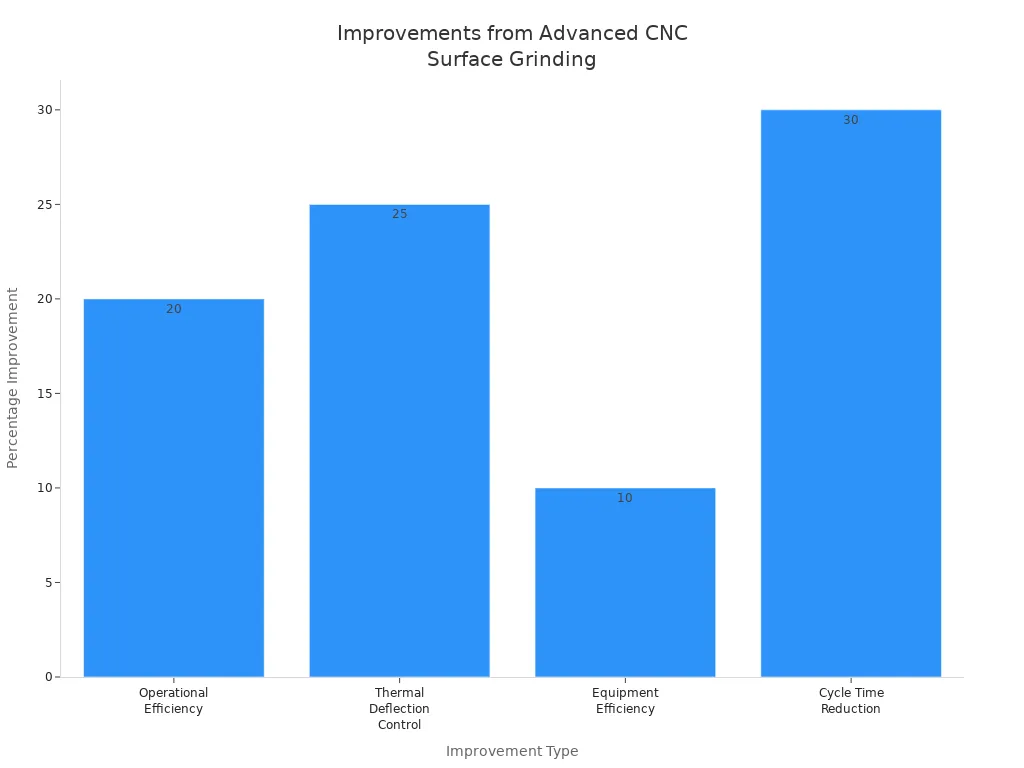
You use CNC Surface Grinder technology to get flat and smooth surfaces. Automation and smart programming help you get great results each time. Advanced systems let you do more jobs and keep the quality high. The table below shows how automation helps you work faster:
Automated Feature | Impact on Production Efficiency |
Material handling systems | Same cycle times, less manual work |
Operators manage multiple stations | More work done, lower costs |
Closed-loop feedback for wheel wear | More accuracy, easier to get good results |
You also get better safety and more work done with new grinding methods.
Key Takeaways
CNC Surface Grinders make flat and smooth surfaces by using machines and smart computer programs. This helps work get done faster and makes the quality better.
Picking the best grinding wheel and coolant is very important. It helps get the right surface finish and makes the tools last longer.
Operators need regular training and help from experts. This helps them keep good work and fix problems fast during grinding.
Using machines in CNC grinding means people do less work by hand. It also makes things faster and keeps results the same for many parts.
Checking the surface finish and following safety rules is very important. This keeps the work good and makes sure everyone is safe at work.
Mastery in CNC Surface Grinding
Precision and Consistency
When you learn to use a CNC Surface Grinder well, you can make parts that are very exact every time. Knowing how to set up the machine is important. You pick the right grinding wheel and choose the best coolant. You change the settings to get the finish you want. This skill is needed because companies want better finishes and tighter limits. New CNC Surface Grinder models have smart technology. These machines do many steps for you. This means fewer mistakes and more steady results.
Tip: Practice and training help you learn good habits. You can spot problems early and fix them fast. This keeps your work looking great.
You also get help from experts. If you have trouble, someone can come and help you quickly. This keeps your work moving and stops delays.
Using the right machine settings, grinding wheels, and coolants makes surfaces smoother.
Training teaches you how to get good results and fix problems.
Expert help stops mistakes and makes your products better.
Role of Automation
Automation is very important in CNC Surface Grinder work today. Robots move parts in and out of the machine. Special systems watch the grinding process and tell you if something changes. These tools help every part turn out the same.
Automation makes work faster and keeps things steady.
Smart controls change feed rates to protect the grinding wheel and keep results even.
You spend less time doing the same job and more time checking your work.
More companies are buying grinding machines now. This shows that CNC Surface Grinder technology helps people work faster and more accurately. When you use automation, you get the same results each time and meet the needs of modern factories.
CNC Surface Grinder Process
Setup and Preparation
First, get your workspace and machine ready. Clean the table so nothing gets in the way. Make sure all your tools are there and ready to use. Hold the workpiece tight so it will not move. Pick the right grinding wheel for your material. Many industries use materials like titanium alloy, aluminum alloy, stainless steel, carbon fiber, Inconel 718, and PEEK. Each material is special and has its own uses. The table below shows some materials and what they are good for:
Material | Performance Characteristics | Common Uses |
Titanium Alloy | Strong, lightweight, corrosion-resistant, stable at high temperatures | Aerospace, medical devices |
Aluminium Alloy | Easy to machine, good heat and electricity conductor, lightweight | Electronics, automotive, aerospace |
Stainless Steel | High strength, excellent corrosion resistance | Medical devices, food equipment |
Carbon Fiber | High strength and stiffness, great fatigue properties | Aerospace, racing cars, robot frames |
Inconel 718 | High temperature resistance, suitable for tough environments | Aero engines, gas turbines |
PEEK | High temperature resistance, chemical resistance, excellent mechanical properties | Medical implants, aerospace insulation |
Programming Essentials
Use the CNC Surface Grinder’s control panel to type in your program. Set the path, speed, and depth for grinding. New machines let you save programs and use them again. This saves time and helps you get the same results each time. Smart systems can change settings for you. These systems use AI to watch and make changes if needed. You can trust the machine to keep your work correct.
Execution and Monitoring
Start the grinding cycle and watch what happens. Check the coolant flow and listen for odd noises. Smart machines can stop if they find a problem. You can see the grinding wheel and workpiece through safety windows. If you see something wrong, stop the machine and fix it. New abrasive wheels, hybrid machines, and robots help you finish jobs faster and better. These new tools make your work safer and easier.
Tip: Always check your setup and program before you start. This helps you stop mistakes and keeps your parts looking good.
Precision Techniques
Grinding Wheel Selection
You must pick the right grinding wheel for your CNC Surface Grinder. The wheel you choose affects how smooth your part will be. The abrasive type and grit size are important. Fine grit makes the surface smoother. Coarse grit removes more material but leaves it rougher. The table below lists common wheel types and their uses:
Wheel Type | Application | Material | Characteristics |
White | Light grinding | Heat-sensitive steels | Friable aluminum oxide, good for light to medium grinding |
Pink | Light to medium grind | Alloyed, heat-sensitive | Fused aluminum oxide with chromium, keeps shape well |
Ruby | Medium to heavy grind | Tool steels | High-purity alumina with chromium, very versatile |
Blue/Gray | Medium to heavy grind | Various metals | Sharp monocrystalline aluminum oxide, cuts aggressively |
Ceramic | Light to heavy grind | Tool steels | Ceramic alumina blend, lasts long and performs very well |
Match the wheel to your material and the finish you want. White wheels work best for heat-sensitive steels. Pink wheels help keep the part’s shape. Ruby and ceramic wheels are good for tool steels.
Note: The abrasive type and grit size change how rough the surface is. Always look at the manufacturer's guide to find the best wheel.
Optimizing Parameters
You can change the grinding process by adjusting settings. These settings are wheel speed, workpiece speed, depth of cut, and feed rate. Each one changes how much material you remove and how smooth the surface gets.
Wheel Speed: Faster speeds can make the surface smoother. Too much speed can cause heat damage.
Workpiece Speed: Slower speeds make the finish better. Lowering speed from 0.5 m/min to 0.2 m/min can make the surface twice as smooth.
Depth of Cut: Shallow cuts (0.005–0.01 mm) help avoid marks. Deep cuts remove more material but can hurt the finish.
Feed Rate: Lower feed rates (0.01–0.05 mm/rev) give a finer finish.
Here is a table that shows how these settings affect your results:
Parameter | Effect on Surface Finish and Material Removal |
Wheel Speed | Higher speeds (30–40 m/s) lower roughness but can cause heat damage. Precision grinding: 25–35 m/s. |
Workpiece Speed | Lower speeds (0.1–0.5 m/min) make the finish better. Example: 0.5 m/min to 0.2 m/min lowers Ra from 0.4 µm to 0.2 µm. |
Depth of Cut | Shallow cuts (0.005–0.01 mm) reduce marks. Deep cuts remove more but may hurt the finish. |
Feed Rate | Lower rates (0.01–0.05 mm/rev) make the finish better. Example: 0.1 mm/rev to 0.02 mm/rev improves Ra by 20%. |
You can use spark-out passes too. This means you run the grinding wheel over the part without cutting deeper. Spark-out passes help remove leftover material and make the surface smoother. Usually, 2–5 spark-out passes at a wheel speed of 25–30 m/s can make the finish 10–20% better.
Coolant Management
Coolant is important in CNC Surface Grinder work. It keeps the grinding wheel and part cool. This stops burns and keeps the tool sharp. The coolant type changes how long the tool lasts and how smooth the surface is.
Coolant Type | Impact on Tool Life | Impact on Surface Quality |
Straight Oils | Lowers wear but can leave sticky buildup | Can cause surface marks |
Emulsions | Makes tool last longer with the right mix | Keeps roughness low |
Semi-synthetics | Doubles insert life at high speeds | Makes walls smoother |
Full Synthetics | Keeps hardness in heat-sensitive metals | Stops damage layers |
MQL | Not as good as full floods | Small marks from uneven coverage |
Pick a coolant that matches your material and grinding style. Emulsions and semi-synthetics often give the best balance between tool life and surface finish. Keep the coolant clean and mixed right. This helps your CNC Surface Grinder last longer and gives better results.
Tip: Always check coolant flow before starting. Good coolant management stops heat damage and keeps your parts looking great.
Surface Finish Control
You need to measure the surface finish to make sure your parts meet standards. Surface roughness, or Ra, tells you how smooth the surface is. You can use different tools to check this:
Testing Method | Description | Accuracy / Use Case |
Profilometer (Contact Stylus) | A diamond tip moves across the surface to record Ra and Rz values. | Very accurate, used in industry. |
Optical (Non-contact) | Uses lasers or white light to scan and make a 3D profile. | Best for delicate or very fine finishes. |
Comparator Plates | Compare your part to plates with known Ra values. | Fast, cheap, not very precise. |
Visual & Tactile | Judge by look and feel. | Only for quick checks, not for specs. |
Contact methods like a stylus probe are very accurate. Non-contact methods, like lasers, are good for fast checks or delicate parts. Skilled machinists sometimes use their eyes and hands for a quick check, but this does not meet strict standards.
Note: Knowing about surface roughness, waviness, and lay helps you control your part’s shape. Always write down your measurements to track quality over time.
Safety and Troubleshooting
Safety Protocols
It is important to stay safe when using a CNC surface grinder. Always wear safety glasses and gloves. This protects your eyes and hands. Keep your work area clean at all times. Remove any loose tools or materials from the table. Make sure all guards and covers are in place before starting the machine.
Never leave the machine running alone. Always turn off the grinder before making changes. Use the emergency stop button if you see something unsafe. Keep coolant systems working well. This stops overheating and lowers the chance of burns.
Tip: Have regular training for everyone who uses the grinder. Training helps you avoid mistakes and keeps you safe.
You can help the environment too. Use energy-saving machines and smart cooling systems. Try to waste less material. These steps make your shop safer and better for the planet.
Common Issues and Solutions
CNC surface grinding can have problems. You might see rough surfaces, tool vibration, or overheating. Most problems can be fixed by checking key settings. The table below shows how different settings change your results:
Parameter | Influence on Surface Quality | Influence on Tool Vibration |
Wheel Speed | Changes quality | Big effect |
Feed Speed | Most important | Big effect |
Depth of Cut | Changes quality | Medium effect |
If you see rough finishes or hear strange sounds, check wheel speed and feed rate first. Change these settings to make the finish better and lower vibration.
You can stop many problems by doing these things:
Check spindle bearings often to find issues early.
Take care of coolant systems to stop overheating.
Make sure clamping mechanisms hold the workpiece tight.
Change feed rate and spindle speed to lower tool wear.
Train operators well to stop programming mistakes.
Do regular maintenance to keep the machine working well.
Remember: A grinder that is cared for works better and lasts longer. Quick checks and small fixes save you time and money.
Applications of CNC Surface Grinder
Aerospace and Automotive
CNC surface grinding is used in car and airplane factories. Factories need flat and smooth parts for engines and gears. These parts must fit together just right. CNC surface grinding helps make parts with tight limits and smooth finishes. You can use titanium or aluminum to make lighter parts. Lighter parts help planes and cars go faster and use less fuel. CNC machines work quickly and do not waste much material. This saves money for the factory.
Precise parts make cars and planes safer and work better.
You spend less money because you waste less material.
You can finish more work in a shorter time.
Tool and Die
CNC surface grinding helps make tools and dies that shape other parts. Tools need sharp edges and smooth surfaces to work well. You can grind hard shapes and keep every tool the same size. This means molds and dies last longer and make better products. CNC machines do most of the work by themselves. This saves money on workers and tool costs.
Tip: Keep your CNC Surface Grinder clean and checked often. This helps your tools stay sharp and your work go smoothly.
Electronics and Medical
CNC surface grinding is important for making electronics and medical parts. In electronics, you need smooth edges and small spaces for circuit boards. You can grind aluminum and magnesium cases with special coatings. These coatings protect devices from problems and help them work well.
CNC machines make exact cases, heatsinks, and board shapes.
You can cut, drill, and shape boards quickly and accurately.
You can make tiny parts that fit inside small devices.
Medical factories need perfect finishes for implants and tools. CNC surface grinding gives the accuracy needed for these parts. You use special wheel dressing and careful checks to keep every part within limits. This helps make safe and strong medical devices for people.
You can get really good at CNC surface grinding by using important techniques that help make better products:
You can make parts that are the right size.
You can get smoother surfaces that last longer.
You can fix shapes that change after heating.
You can work with tough materials using special tools.
You can keep shapes and positions very exact.
You can use less force to keep things steady.
Doing things the right way makes work safer and faster. The table below shows how new machines help you do a better job:
Feature | Benefit |
Precision controls | Very small changes make parts more exact |
Advanced cooling systems | Stops heat from changing the part’s shape |
Safety features | Keeps workers safe |
Smart CNC methods help machines get better as they work. Keep learning new things so you can do more and be helpful at your job.
FAQ
What is the main benefit of CNC surface grinding?
You get very flat and smooth surfaces. CNC machines help you make parts with tight limits. You can repeat the same job many times and get the same results each time.
How do you choose the right grinding wheel?
You look at the material you want to grind. You pick a wheel with the right grit and hardness. Always check the manufacturer's guide for the best match.
Why does coolant matter in surface grinding?
Coolant keeps your part and wheel cool. It stops burns and helps the wheel last longer. Good coolant flow gives you a better surface finish.
Can you use CNC surface grinding for small parts?
Yes, you can. CNC surface grinders work well for both small and large parts. You just need to set up the machine and hold the part tight.
What should you do if you see sparks or hear loud noises?
Stop the machine right away. Check your setup, wheel, and coolant. Fix any problems before you start again. This keeps you safe and protects your parts.