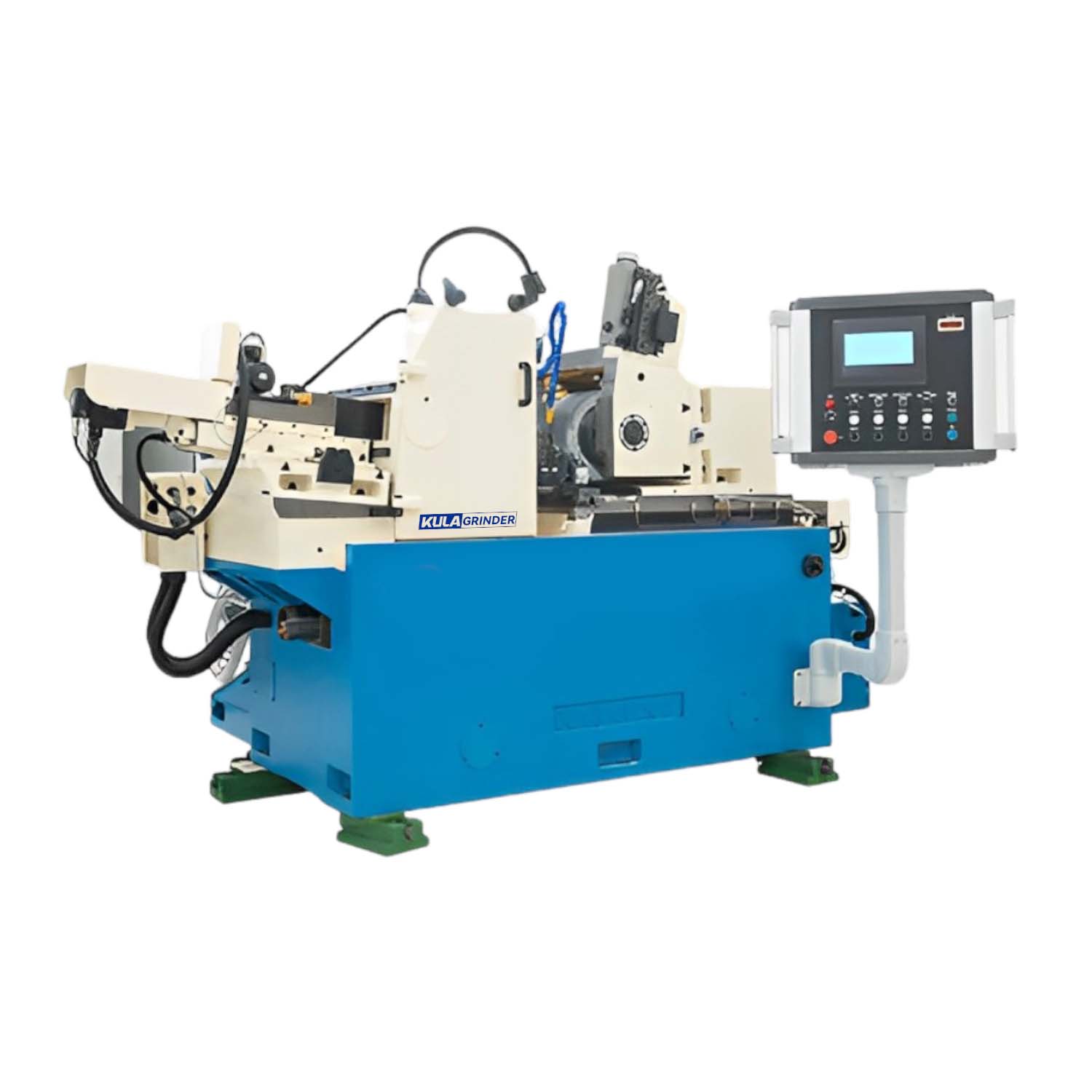
Many manufacturers still view centerless grinding purely as a legacy method for mass-producing simple dowel pins. You might think it lacks the finesse required for today's intricate manufacturing demands. This outdated misconception masks a powerful reality. The modern CNC Centerless Grinder stands as a sophisticated, high-precision solution capable of tackling complex geometries, challenging superalloys, and remarkably tight tolerances.
When conventional grinding struggles with part deflection or lengthy setup times, this technology steps in to solve critical manufacturing bottlenecks. We will explore how making the shift fundamentally changes floor efficiency and part quality. This guide serves as both a technical and operational roadmap. You will discover the hidden advantages of centerless systems, evaluate advanced features like automated dressing, and understand the practical realities of implementation. Let us dive into the mechanics and operational shifts making this equipment a modern industrial necessity.
Key Takeaways
Continuous processing without spindle stops drastically reduces per-part cycle times, fundamentally altering ROI equations for high-volume runs.
Full-length workpiece support eliminates deflection, making centerless grinding the only viable option for long, thin, or brittle materials.
Modern CNC centerless grinders bridge the gap between mass production and high-mix custom manufacturing through automated dressing and in-process gauging.
Adoption requires careful evaluation of implementation realities, specifically regarding operator training for regulating wheel adjustments and troubleshooting harmonics (lobing).
The Business Case: Where Conventional Grinding Creates Bottlenecks
To understand the value of centerless technology, we must first examine the inherent limitations of between-centers grinding in high-production environments. Conventional grinding relies on chucks, collets, or centers to hold the workpiece. This approach inherently creates process bottlenecks.
Problem Framing: The Burden of Between-Centers Processing
Between-centers grinding introduces unavoidable downtime. Operators must prepare center holes on every single part before it ever reaches the grinder. Once at the machine, the cycle stops completely for loading and unloading. An operator or robot must unclamp the finished part, clear the work area, insert the new blank, and re-clamp it. These seconds add up rapidly during high-volume runs. Chucking inconsistencies also introduce runout errors, requiring frequent manual adjustments and increasing the likelihood of scrapped parts.
The Cost of Deflection on Thin Parts
Traditional workholding holds parts securely at their extreme ends. When a grinding wheel applies cutting force to the middle of a slender shaft, the part acts like a bridge under a heavy load. It bends. We call this bending stress "deflection." Deflection makes achieving tight dimensional accuracy nearly impossible on long or thin components. The part pushes away from the wheel in the center, resulting in a barrel shape or severe taper. Manufacturers often try to counter this by taking extremely light, slow passes, which destroys production throughput.
Common Mistakes in Workholding
A common error is attempting to grind custom, slender parts between centers without adequate steady rests. Facilities waste countless hours trying to dial in complex steady rest configurations. Even then, they often experience high scrap rates due to chatter marks and geometric distortion.
Throughput vs. Footprint Inefficiency
Because conventional grinding cycles are interrupted by constant loading and unloading, throughput remains strictly limited. To meet high-volume production quotas, factories often deploy multiple conventional grinding machines. This scaling strategy consumes valuable floor space. It multiplies maintenance requirements. It also drastically increases labor overhead, as you need more operators to manage the larger fleet of machines. A single, optimized centerless system can often match or exceed the output of several conventional machines combined.
Comparison of Grinding Bottlenecks
Process Factor
Conventional Between-Centers Grinding
Centerless Grinding
Workpiece Support
Supported only at the ends
Supported along the entire length
Load/Unload Time
High (requires stopping the cycle)
Zero to Minimal (continuous feeding possible)
Upstream Prep
Center holes required
No center holes needed
Space Efficiency
Low (requires more machines for high volume)
High (one machine produces massive volume)
Uncovering the "Hidden" Advantages of Centerless Systems
Moving away from traditional workholding unlocks secondary benefits that profoundly impact manufacturing operations. These hidden advantages extend far beyond simple cycle time reductions.
Advantage 1: Unmatched Rigidity for Complex and Custom Parts
The physics of centerless grinding provide a structural masterpiece. The workpiece sits on a work rest blade. The regulating wheel presses it against the main grinding wheel. This three-point configuration supports the component continuously along its entire length. There is no unsupported middle section to bow or bend.
This unmatched rigidity delivers a massive commercial outcome. You can apply aggressive material removal rates to ultra-thin custom parts without geometric distortion. Brittle materials, such as technical ceramics or aerospace superalloys, often crack under the bending stresses of conventional grinding. Centerless support allows rapid, heavy stock removal on these delicate materials, expanding your capability to take on advanced manufacturing contracts.
Centerless grinding eliminates the need to drill center holes. This single fact transforms your upstream operations. In a standard workflow, every shaft must go through a lathe or specialized centering machine just to prep it for the grinder. By removing this requirement, you eliminate an entire manufacturing step.
The commercial outcome is immediate. You reduce overall manufacturing lead time significantly. You save money on center-drilling tooling. You also eliminate the material handling labor required to move batches between the centering station and the grinding department. The part flows directly from basic turning or cutting operations straight into the grinding phase.
Advantage 3: Dynamic Automation Integration
A modern CNC Centerless Grinder is inherently designed for seamless automation. Because you do not need to pause a spindle to chuck a part, the machine integrates perfectly with continuous feeding mechanisms.
You can easily pair these systems with vibratory bowl feeders, step feeders, and gantry loaders. For thru-feed applications, parts push each other continuously through the grinding zone. This dynamic setup facilitates true "lights-out" manufacturing. Operators load a hopper at the end of their shift, and the machine runs unattended through the night. This capability drastically lowers operator-to-machine ratios, allowing one technician to oversee several automated cells simultaneously.
Evaluating a CNC Centerless Grinder: Features to Outcomes
Not all centerless machines offer the same capabilities. Modernizing your floor requires evaluating specific CNC features and aligning them with your production goals.
Infeed vs. Thru-feed Capabilities
You must match the grinding method to your part application. Centerless grinding generally falls into two distinct operational modes:
Thru-feed Grinding: The parts pass straight through the machine from front to back. This method perfectly suits straight, uniform cylinders like dowel pins, simple shafts, and piston rings. It offers the highest possible throughput.
Infeed (Plunge) Grinding: The part is placed onto the blade, and the wheels plunge inward. This method accommodates multi-diameter parts, headed pins (like engine valves), or custom-profiled components that cannot pass completely through the wheels.
Advanced CNC Dressing Technology
Historically, profiling a grinding wheel required physical metal templates and mechanical tracing mechanisms. This made changing profiles for different parts incredibly tedious. Today, advanced CNC technology shifts dressing into the digital realm.
Using CNC-interpolated dressing, a diamond tool moves along two axes to carve complex profiles directly into the grinding and regulating wheels. You program the shape via the control interface. The outcome is sub-micron control over wheel profiles. It reduces setup times drastically, transforming centerless grinding from a mass-production-only process into a viable solution for high-mix, custom batch transitions.
In-Process Gauging and Auto-Compensation
Maintaining tight tolerances over a long shift requires constant vigilance. Thermal expansion in the machine casting and gradual wear on the grinding wheel cause dimensional drift. Modern systems integrate laser or tactile gauging directly into the exit chute or grinding zone.
How Auto-Compensation Works:
The gauge measures the diameter of the finished part immediately after it exits the wheels.
The system feeds this precise dimensional data back to the CNC control unit.
The software calculates any deviation from the nominal target size.
The machine automatically commands servo motors to advance the wheel by a fraction of a micron, compensating for wear.
This closed-loop system eliminates thermal drift entirely. It guarantees strict CpK (process capability) compliance and minimizes scrap rates without requiring manual operator intervention.
Implementation Realities: Dispelling the "Magic" Myth
Despite its immense power, centerless grinding is not magic. It relies on precise physics. Adopting this technology requires a clear-eyed view of implementation challenges and operational demands.
The Lobing Challenge (Harmonics)
One of the most notorious challenges in centerless grinding is "lobing." A part can measure perfectly consistent in diameter but still be shaped like a triangle (out-of-round). This happens because the part center floats. If the harmonic frequencies of the rotating part sync poorly with the wheel speeds, a lobed shape forms.
Achieving perfect roundness requires strict, knowledgeable control over the setup. The operator must accurately calculate the work rest blade angle. They must also set the part height perfectly above the centerline of the wheels. Adjusting regulating wheel speeds breaks up these harmonic patterns.
Best Practices for Defeating Lobing
Always start with the workpiece center positioned roughly one-half the part diameter above the centerline of the wheels. Ensure the work rest blade angle matches the specific material and diameter requirements—typically ranging from 15 to 30 degrees. If lobing persists, slightly alter the regulating wheel RPM to disrupt the harmonic rhythm.
Operator Skill Requirements
You must be transparent about the learning curve. Yes, CNC controls simplify data entry, automated dressing, and wheel compensation. However, setting up the machine still requires foundational grinding expertise. The operator must understand how to align the regulating wheel housing, select the correct blade material, and troubleshoot surface finish issues. You cannot simply pull a novice off the street, press a button, and expect flawless aerospace components. Invest heavily in specialized training during the implementation phase.
Maintenance and Thermal Stability
Continuous grinding removes massive amounts of material, generating extreme heat and microscopic swarf. To maintain sub-micron tolerances over continuous shifts, you need robust auxiliary systems.
Your coolant filtration system must be top-tier. If abrasive swarf recirculates into the grinding zone, it will destroy the surface finish of your custom parts. Additionally, spindle maintenance and chiller units are mandatory. By regulating the temperature of the coolant and the spindle bearings, you prevent thermal expansion from distorting the machine geometry during heavy production runs.
Troubleshooting Common Quality Issues
Defect Type
Probable Cause
Recommended Solution
Tri-Lobing (Out of Round)
Part sits too low on the blade
Raise the blade height above centerline; change wheel speed.
Taper on Part Ends
Incorrect guide plate alignment
Realign entry and exit guide plates to the regulating wheel.
Chatter Marks (Visual lines)
Blade angle too steep or wheel too hard
Reduce blade angle; dress the wheel for a more open structure.
Shortlisting Logic: Is a CNC Centerless Grinder Right for Your Floor?
Before overhauling your manufacturing floor, you must validate whether your part portfolio justifies the technological shift. Consider these critical thresholds.
Volume Thresholds
Define the tipping point. Centerless technology requires setup time to dial in the blade, wheels, and guides. Therefore, it is most profitable for high-volume continuous runs or recurring mid-volume batches. If you run families of similar parts where changeovers only require minor CNC program tweaks, the ROI is excellent. However, it is rarely cost-effective for one-off prototyping or job shops where every single part looks vastly different.
Part Geometry Validation
Confirm your part suitability. The process demands a continuous cylindrical surface to drive smoothly against the regulating wheel. If your part features heavy, deep keyways, large cross-holes, or non-symmetrical flats, it will bounce on the work rest blade. While you can sometimes grind these parts using specialized guides or segmented wheels, they heavily complicate the setup and reduce throughput. Perfectly round, uninterrupted cylinders yield the best results.
Next-Step Action
Do not rely solely on brochure specifications. We recommend commissioning a formal time-study and requesting a test grind from equipment OEMs. Send them a batch of your toughest blanks. Ask them to validate the exact cycle times, roundness specifications, and wheel-wear assumptions on their equipment. This empirical data ensures your capital expenditure aligns perfectly with reality before any equipment hits your floor.
Conclusion
The true advantage of a modern CNC system extends far beyond raw spindle speed. It lies in the structural rigidity that eliminates deflection, the removal of upstream centering operations, and its inherent readiness for lights-out automation. By supporting parts continuously, you conquer the physics that cause conventional grinding to fail on complex, delicate components.
We encourage manufacturing buyers to look past the initial capital cost of the machine. Instead, evaluate the overall long-term capability expansion and the dramatic increase in manufacturing throughput. When implemented with the right operator training and robust auxiliary systems, centerless grinding transforms production bottlenecks into your most reliable, highly automated profit centers.
FAQ
Q: Can a CNC centerless grinder hold tighter tolerances than a standard cylindrical grinder?
A: Yes, in many applications. By eliminating center holes, you remove the alignment errors associated with poor center preparation. Furthermore, full-length workpiece support completely prevents part deflection during the cut. This makes achieving micron-level straightness and cylindricity much more reliable, especially on long or slender components.
Q: Is centerless grinding viable for high-mix, low-volume production?
A: Historically, long mechanical setup times made it unsuitable for small batches. However, modern CNC automated dressing and software-driven auto-compensation have dramatically reduced changeover times. While it remains ideal for mass production, these digital advancements make recurring mid-volume or high-mix production runs highly viable and profitable today.
Q: What materials are best suited for centerless grinding?
A: You can successfully grind a vast array of materials. It easily handles soft plastics, aluminum, and brass, while also excelling with hardened steel, aerospace superalloys, and brittle technical ceramics. The inherent rigidity of the process prevents cracking in fragile materials and allows aggressive stock removal on the hardest metals.