Small components and intricate grooves demand extreme precision in grinding. When working with thin or indexed features, even minor setup errors can compromise quality and repeatability. A CNC Surface Grinder provides the accuracy and automation needed, but success still depends on process knowledge and careful parameter control. At KULA Precision Machinery, we see how manufacturers across aerospace, medical, mold, and electronics industries rely on these machines to push limits while maintaining consistency.
Common failure modes when grinding small or intricate features
Chatter, burning, and poor flatness — root causes and first checks
Chatter marks, surface burns, and uneven flatness are among the most frequent issues when grinding delicate parts. Chatter often results from poor wheel balance, insufficient rigidity, or resonance between the spindle and the part setup. Burns occur when excessive heat builds up due to high infeed rates or inadequate coolant flow. Poor flatness is usually a symptom of unstable fixturing or wheel wear. The first step in troubleshooting is always checking wheel condition, clamping integrity, and machine alignment before diving deeper into process changes. Shops that skip these early checks often waste hours tweaking parameters that cannot compensate for a fundamental mechanical issue.
Wheel glazing and loading — symptoms and remedies
Wheel glazing appears when abrasive grains become dull and no longer cut efficiently, creating a shiny wheel surface. Loading happens when workpiece material clogs the wheel pores, especially when grinding softer alloys or plastics. Both conditions increase heat generation and reduce finish quality. Dressing the wheel at the right frequency, using the correct grit size, and adjusting coolant direction are proven solutions. On CNC Surface Grinders, automatic dressing cycles keep the wheel sharp without operator intervention, which is particularly valuable when grinding high volumes of small parts. Adding a periodic “touch dress” can also prevent glazing before it causes noticeable defects, saving scrap and rework.
Fixturing & support strategies for repeatable accuracy
Low-profile clamps, parallel supports and micro-fixtures for small parts
The fixture defines whether a part can be ground consistently. For small workpieces, standard vises or clamps may obstruct the wheel path or distort the surface. Low-profile clamps and parallel support blocks maximize wheel access while keeping the part stable. Dedicated micro-fixtures can hold multiple small parts at once, improving throughput and maintaining repeatability across a batch. Economic Saddle Surface Grinders often benefit from modular fixture plates, enabling quick setups for different small-part geometries. In high-mix environments, shops often invest in standardized fixture bases that allow quick swaps of part-specific inserts without recalibrating the entire setup.
Avoiding part deformation from over-clamping
Over-clamping can warp delicate parts, leading to dimensional errors after release. Even flat surfaces may appear accurate under stress but deviate once unclamped. The best practice is to apply even clamping force, use soft jaws or vacuum fixtures, and rely on full-surface support. CNC Saddle Surface Grinding Machines often pair with precision magnetic chucks, which hold small components securely without mechanical distortion, striking the right balance between holding power and minimal stress. For ultra-thin parts, vacuum chucking combined with support plates can eliminate distortion while still keeping the part stable during grinding.
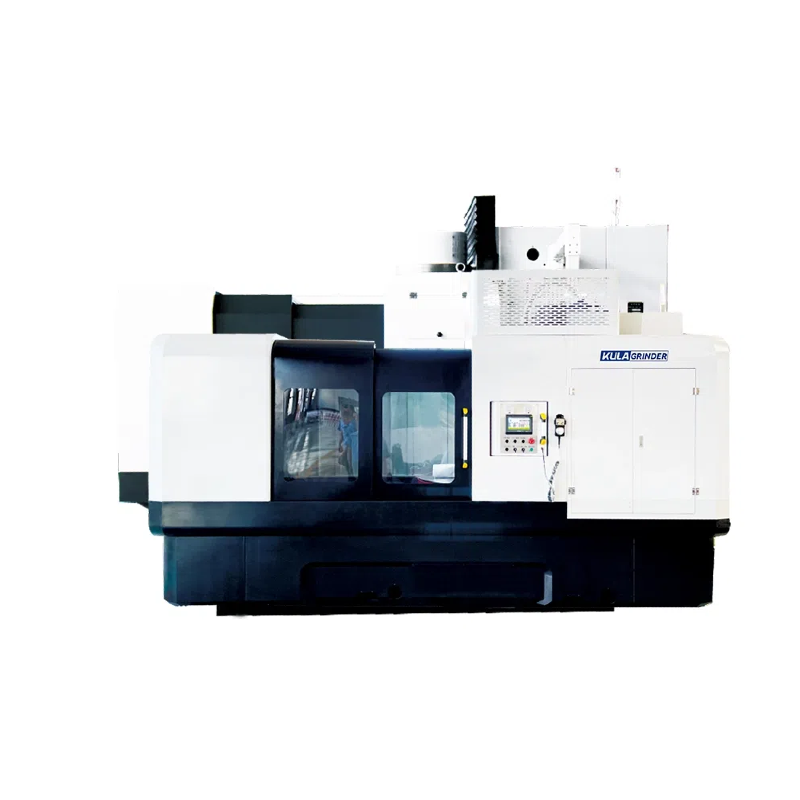
Wheel shaping, form dressing and indexing for grooves & molding
Single-point vs rotary dressers and when to use each
Grooves, radii, and molded profiles require precise wheel shaping. A single-point dresser offers fine control for sharp corners and small radii, making it ideal for prototype or short-run jobs. Rotary dressers, on the other hand, are more efficient for repetitive production of complex profiles, as they maintain wheel shape longer and deliver consistent dressing results. Choosing the correct dressing method directly affects accuracy and tool life, especially when producing indexed features. Shops should consider wheel hardness and dressing frequency together, since aggressive dressing on a soft wheel can shorten life unnecessarily.
Using DXF-based form dressing to reproduce complex profiles
CNC Surface Grinders equipped with digital control systems can translate DXF files into dressing paths. This feature allows shops to replicate CAD-designed grooves or molding profiles directly on the wheel. It ensures repeatability across batches and reduces programming effort. For industries like mold manufacturing and electronics, where fine details and geometric accuracy are critical, DXF-driven dressing enables mass production of complex forms with micron-level precision. By integrating this capability with automatic wheel compensation, operators can maintain consistent dimensions even as wheel wear progresses across long production runs.
Feeds, speeds, coolant and balancing for fine finishes
Selecting feed per wheel revolution, depth-per-pass strategies
When grinding small or fragile parts, the cutting parameters must be carefully tuned. Too high a feed or depth-per-pass risks burning and poor finishes, while too conservative a setting increases cycle time unnecessarily. A common best practice is to begin with shallow passes, gradually increasing until reaching an optimal balance of efficiency and surface quality. CNC column surface Grinding Machines, with their robust column design, allow for stable heavier passes, while saddle machines may favor lighter feeds for intricate features. Documenting these settings in a parameter library helps operators quickly recall proven setups for similar parts.
Coolant selection and delivery to avoid heat checks and burning
Coolant plays a decisive role in preventing thermal damage. Water-based coolants with the right additives ensure both lubrication and heat dissipation. The key is not just coolant type but delivery: nozzles must direct fluid exactly into the grinding zone to flush away swarf and maintain consistent cooling. High-pressure delivery systems are particularly valuable when grinding grooves, as they reach into narrow gaps where heat can quickly build up. For precision jobs, filtering coolant to remove fine grit particles prevents scratches on the finished surface and extends wheel life.
Inspection, traceability and process validation
Measuring flatness, surface roughness, and indexing accuracy
A grinding process is only as good as its measurement strategy. For small parts, high-resolution surface testers and optical comparators are often required to check surface finish and flatness. Indexing accuracy must be validated using coordinate measuring machines (CMMs) or rotary encoders, ensuring groove alignment and spacing meet specifications. Without precise inspection, even the best grinding setup cannot guarantee consistent quality. Increasingly, CNC Surface Grinders are integrated with in-machine probing systems, allowing automatic measurement and compensation before parts are removed from the chuck.
Creating a simple GO/NOGO and SPC plan for production
For production runs, manufacturers benefit from structured inspection routines. GO/NOGO gauges allow quick checks without slowing down output, while Statistical Process Control (SPC) methods monitor variation across batches. CNC Surface Grinders with digital process monitoring make it easier to link machine data directly to SPC software, improving traceability and reducing the risk of defective parts reaching downstream assembly. This combination of in-process monitoring and end-of-line inspection ensures every batch meets customer standards. Over time, SPC records also provide valuable feedback for process improvement, enabling tighter tolerances and more predictable cycle times.
Conclusion
Grinding small parts, grooves, and indexed features requires more than just a capable machine—it demands a complete process strategy. From fixturing and wheel dressing to coolant delivery and inspection, every step influences final accuracy. A CNC Surface Grinder from KULA Precision Machinery provides the automation, stability, and repeatability needed to master these challenges, whether using an Economic Saddle Surface Grinder for cost-effective setups or a CNC column surface Grinding Machine for heavy-duty accuracy. For manufacturers aiming to improve performance on delicate or complex features, the path is clear: setup carefully, shape wheels precisely, control process parameters, and validate outcomes. Contact us today to learn more about our grinding solutions or to arrange a trial grind on your parts.


