You can find many types of honing machines. These include horizontal, vertical, manual, semi-automatic, fully automatic, rigid, and flexible models. Each machine is made for a special job. Vertical honing machines help you get very accurate results in big jobs, like making car cylinders. Horizontal honing machines are best for long holes, such as in hydraulic cylinders. Hand-held honing tools are good for small parts and fast fixes. Rigid honing machines take away more metal and make holes better shaped. Flexible hones are used to finish and smooth out holes that are already there.
Type | Best For |
Vertical Honing Machines | High-precision, large-scale production |
Horizontal Honing Machines | Long bores, horizontal alignment |
Hand-held Honing Tools | Small parts, field repairs |
Key Takeaways
Honing machines have different types. These include vertical, horizontal, manual, semi-automatic, and fully automatic. Each type is made for a special job. Vertical honing machines are very good for big parts. Horizontal machines work best for long holes. These are important in car and airplane factories. Manual and semi-automatic honing machines are good for small shops. They save money and let workers make changes while working. Fully automatic honing machines use new technology. They help make things fast with little help from people. Picking the right honing machine depends on what you need. You must think about how exact you want the work. You should also think about the size of the part and how many you need to make.
Types of Honing Machines
Horizontal Honing Machine
Horizontal honing machines are widely used for producing precise, long holes, such as those found in hydraulic cylinders or engine blocks. These machines are versatile, capable of handling both small and large jobs. The machining diameter typically ranges from 3 mm to 60 mm, with a stroke length that can extend up to 160 mm. Some models, like the HM Series, are equipped with advanced features, including servo-driven tool feeds and precise size control systems for high accuracy.
| Specification | HM2000 | HMI2000 |
| Machining Diameter (ID) | φ3 - φ60 mm (0.12 - 2.36 in.) | φ3 - φ50 mm (0.12 - 1.97 in.) |
| Machining Length | 0 - 260 mm (0 - 10.24 in.) | / |
| Spindle Speed | 250 - 2500 r/min | 250 - 2500 r/min |
| Spindle Motor | 1.5 kW | 1.5 kW |
| Stroke Motor | 0.75 kW | 0.75 kW |
| Stroke Length | 0 - 160 mm (0 - 6.30 in.) | 0 - 160 mm (0 - 6.30 in.) |
| Stroke Speed | 80 - 310 rpm | / |
| Feed Resolution | / | 0.001 mm (0.00004 in.) |
| Feed Drive | / | Servo motor |
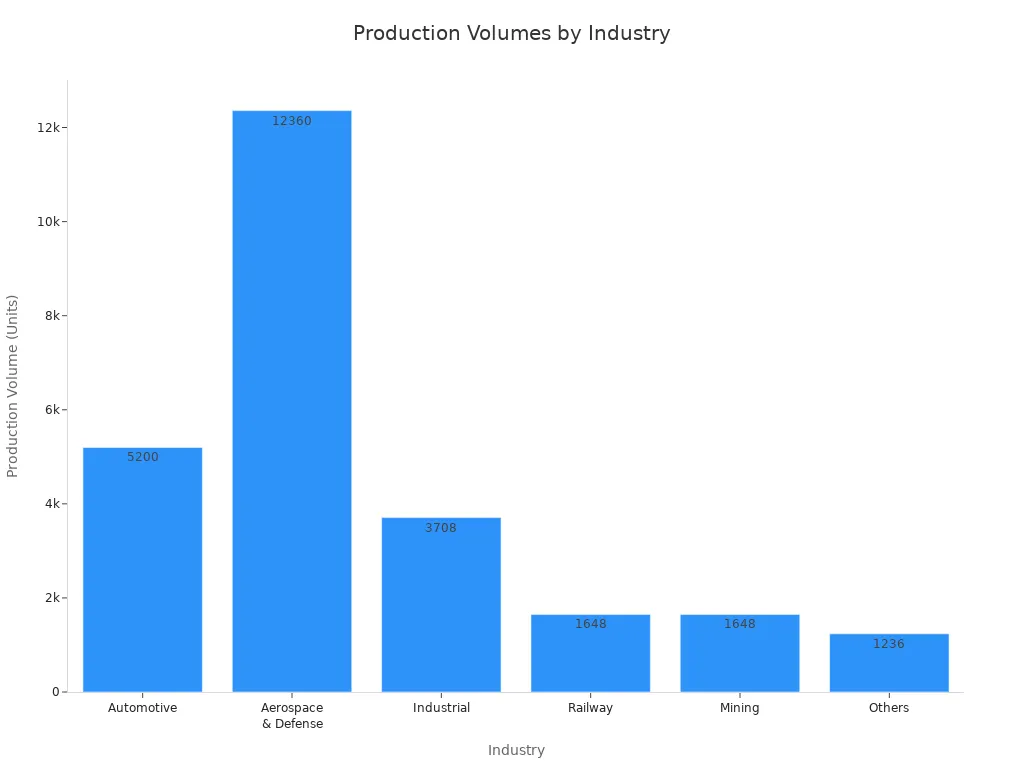
You will see horizontal honing machines in many industries. Here are some places where they are used:
Industry | Production Volume (Units) | Typical Applications |
Automotive | 5,200 | Cylinder blocks, crankcases, piston rods, EV transmission casings |
Aerospace & Defense | 12,360 | Aircraft hydraulic systems, landing gear cylinders, turbine engine liners |
Industrial | 3,708 | Hydraulic actuators, bushings, pump housings, custom tools |
Railway | 1,648 | Axle boxes, braking systems, dampers |
Mining | 1,648 | Drilling equipment, hydraulic actuators, wear-resistant cylinder finishing |
Others | 1,236 | Medical implant production, especially orthopedic devices |
Horizontal honing machines are known for being accurate and fast. The design is comfortable, and the touchscreen is easy to use. People pick this machine when they need to make many parts quickly and with good accuracy.
Vertical Honing Machine
Vertical honing machines are very precise, especially for big holes. They keep the centerline straight, so your parts come out right. You can put more than one spindle next to each other. If one spindle breaks, you can still use the others because of the modular design.
Tip: Vertical honing machines are best for jobs that need high precision, like in cars and airplanes.
You can use vertical honing machines for these jobs:
Making surfaces smoother and more exact
Building car engines
Making airplane parts
Finishing hydraulic cylinders
Working on general industrial machines
Applications | Limitations |
Improving surface finish and dimensional accuracy | Limited machining capacity |
Automotive engine manufacturing | Longer setup periods compared to other techniques |
Aerospace component production | Issues with noise and dustiness |
Hydraulic cylinder finishing | N/A |
General industrial machinery | N/A |
Vertical honing machines can take longer to set up and can be loud. But you get the best results for big, accurate parts.
Manual Honing Machine
Manual honing machines let you control the process. You need some skill to use them well. They do not cost as much, so small shops like them. They are good for small batches or special jobs.
Factor | Manual Honing Machines | Automated Alternatives |
Cost | More cost-effective for small businesses | Higher initial investment |
Precision | Generally lower precision | Higher precision |
Cycle Time | Slower cycle times | Faster cycle times |
Integration | Simpler integration | Better integration with manufacturing |
Ease of Use | Simpler operation | More complex but efficient |
Manual honing machines are slower and not as exact as automatic ones. But you can set them up fast and use them for many different parts.
Semi-Automatic Honing Machine
Semi-automatic honing machines are a mix of manual and automatic types. Medium-sized companies and repair shops use them. You can change settings while the machine works. This helps when you have different materials or part sizes.
Scenario Type | Benefits |
Medium-sized enterprises | Higher productivity and consistency compared to manual machines. |
Aftermarket service providers | Allows operator intervention and adjustments as needed. |
Diverse applications | Capable of handling a broader range of workpiece sizes and materials, especially in automotive and industrial sectors. |
Moderate price point | Easier integration into existing workflows, contributing to growing market share. |
Semi-automatic honing machines fit well into your current work. They work faster than manual machines and cost less than fully automatic ones.
Fully Automatic Honing Machine
Fully automatic honing machines use advanced technology for the best speed and accuracy. They have CNC controls, robots, and real-time monitoring. Big factories use them to make lots of parts fast with little human help.
CNC controls make the machine more exact and automatic.
Robots move parts and tools, so people do not have to.
Real-time monitoring changes settings for the best results.
You get more work done, waste less, and make better parts.
Consumable | Quantity |
Hydraulic Oil | Multi Grad 32/10 Gal |
Honing Oil | 40 Gal |
Honing Head | ANR160A |
Fuse | FRZ ATDR30 GLS/600V/30A (#3) |
Fuse | 5A (#1) |
Fuse | 3A (#6) |
Fuse | 1A (#3) |
Filter | Paper media coolant roll (#1) |
Oil Filter (Power Unit) | Buyers HFA51025 |
Fully automatic honing machines help you work faster and make every part the same. They make your factory run better and help you meet strict quality rules.
Rigid vs. Flexible Honing Machines
It is important to know how rigid and flexible honing machines are different. Each type helps you reach certain goals in your shop.
Rigid Honing Machine Features
Rigid honing machines give you very accurate results. They fix small mistakes from earlier steps. These machines help you get the right size and smooth surfaces. You can keep tight measurements, which is important in cars and airplanes. If you want parts to fit well and last longer, choose a rigid honing machine.
Note: Rigid honing machines are best for making parts more exact and smoother.
Flexible Honing Machine Features
Flexible honing machines can work with many shapes and sizes. You can use them for different materials and types of holes. Here are some features that make flexible honing machines special:
Multi-stroke honing uses smart tools with servo control.
The abrasive tool moves back and forth and changes size to fit the part.
Custom designs let you use different abrasive lengths and widths.
You can work with many materials, which makes the machine more useful.
Advanced technology helps you get better results and work faster.
Flexible honing machines help you finish parts with rough surfaces. You get steady results and do not remove much material.
Applications and Advantages
You need to pick the right honing machine for your job. Rigid honing machines are good for jobs that need high accuracy. Flexible honing machines are good for many tasks, like making car parts and engines.
Type of Honing | Advantages | Applications |
Rigid Honing | Makes parts more exact and smoother | Good for jobs needing high accuracy |
Flexible Honing | Works with rough surfaces, gives steady finishes with little material removed | Used for many jobs, like cars and engines |
Flexible honing machines are great for making gears and hydraulic parts. They can lower gear noise by 20-30% and make gears last 15% longer. Hydraulic parts have 20% fewer problems after flexible honing.
Tip: If you need to finish parts with tricky shapes or want better results, flexible honing machines give you more choices.
Pick rigid honing machines for jobs that need exact sizes and smooth finishes. Flexible honing machines help you work with many kinds of parts and materials, making your shop more useful.
Types of Honing Operations
There are different types of honing operations you can pick. Each one helps you get a certain result in your shop. Some remove material, some make surfaces smoother, and some create high-quality finishes. Let’s see the main types of honing operations and how you can use different honing machines for each.
Rough Honing
Rough honing takes off a lot of material fast. You do this step before you finish the part. The honing machine uses abrasive belts made from things like silicon carbide or aluminum oxide. These belts touch the workpiece all the time. They are good for jobs where you need to make many parts.
Parameter | Influence on Roughness | Influence on Material Removal Rate |
Grain Size | High | High |
Density of Abrasive | High | N/A |
Pressure of Abrasive Stones | High | High |
Tip: Rough honing gets the part ready for finishing. It works fast and saves you time.
Finish Honing
Finish honing makes the surface smooth and fixes the size. You do this after rough honing. The honing machine makes a crosshatch pattern with lines that go both ways. This pattern helps oil stay between moving parts and stops them from wearing out.
You can get a very smooth surface with a low Ra value.
Multi-step honing, called plateau finishing, leaves valleys for oil and a bigger area for contact.
Note: Finish honing is important for engine cylinders and hydraulic parts. You get surfaces that last longer and work better.
Microhoning (Superfinishing)
Microhoning, or superfinishing, makes parts even smoother and stronger. You use this step to make parts last longer and work better. The honing process lowers friction, helps chips move, and makes cutting edges stronger. You also get better coating and tools last longer.
Machine Type | Applications |
CNC Micro-Honing | Aerospace, medical devices, electronics, automotive, industrial machinery |
| Engine components, transmission systems, fuel injectors, turbine blades, hydraulic cylinders |
| Landing gear assemblies, ensuring surface integrity and fatigue resistance in critical components |
Microhoning helps you get very smooth surfaces and exact shapes. You can use it for slide bearings, cylinder liners, and other parts that need to be finished well.
Free Form Honing
Free form honing lets you make tricky shapes and surfaces. You can use this to lower piston ring tension and help engines use less fuel. Unlike regular honing, which is for round shapes, free form honing gives you more design choices.
Free form honing is good for parts with special shapes. You get better results and less friction.
Type of Honing Operation | Description |
Mechanical Honing Operations | Uses machines for steady and exact work, great for CNC shops. |
Manual Honing Operations | Controlled by a person, gives more freedom but less accuracy, used for small batches. |
Horizontal Honing Machines | Good for long holes, often used in cars for engine cylinders. |
Vertical Honing Machines | Made for short parts, gives high accuracy, often used for medical devices. |
You can pick the right honing machine and operation for your job. Each type helps you get the best finish and accuracy for your parts.
You can pick from many honing machines. Each one is good at something different. The table below shows how each type can help you:
Honing Machine Type | Efficiency | Quality |
Single-pass | High | Repeatable accuracy |
Mechanical | Precise | High accuracy |
Manual | Slower | Flexible, less precise |
Horizontal | Great for bores | Engine cylinders |
Vertical | Short parts | Medical devices |
When you choose a honing machine, remember these things: Match the machine to your work and the shape of your part. Think about how well the machine works and how much it will cost over time. Make sure the machine gives you the right finish and size.
Honing makes parts smooth and the right size. You can make better parts and save time if you pick the best honing machine and way to use it.
FAQ
What is the main purpose of honing machines?
Honing machines make surfaces smoother and more accurate. They help you fix small mistakes from earlier steps. You can use them to make holes and shapes more exact. This is important for parts in engines, hydraulic systems, and medical devices.
How does a cnc honing machine improve accuracy?
A cnc honing machine uses computers to control the process. You set how accurate you want the part to be. The machine follows your settings and changes as needed. This gives you the same results every time. It helps you make fewer mistakes and saves time.
Can you use cnc honing for different materials?
You can use cnc honing for steel, aluminum, and other metals. The machine changes its settings for each material. This helps you get the right surface finish and accuracy. You can work with many shapes and parts. Every job gets better accuracy.
Why is accuracy important in honing operations?
Accuracy makes sure parts fit and work well together. It stops leaks, friction, and early damage. Honing gives you the accuracy needed for engines, gears, and hydraulic cylinders. Your parts last longer and work better. High accuracy also helps you meet strict quality rules.
What are the benefits of cnc honing compared to manual honing?
Cnc honing is more accurate and faster than manual honing. You set the process once, and the machine repeats it for every part. Manual honing depends on your skill and takes longer. Cnc honing makes fewer mistakes and works well for big batches and tricky shapes.
Tip: Pick cnc honing if you need high accuracy and the same results for every part.