Tighter tolerances on tiny parts are pushing legacy grinding setups to their limits. A Combined OD and ID grinding machine combines multiple operations in one clamping to control variation and cost. In this article, you’ll see how these machines work and when they deliver the strongest gains for small components.
What Is a Combined OD and ID Grinding Machine for Small Components?
A Combined OD and ID grinding machine is a CNC grinder that handles both external and internal surfaces in one setup. It typically combines multiple spindles, a high-precision workhead, and programmable axes for flexible positioning.
How a combined OD and ID grinding machine works in a single setup
The core idea is simple. You clamp the part once. The workhead rotates the component. An OD wheel approaches from outside. An ID spindle reaches into the bore.
The machine coordinates these motions through the CNC control. Axes move along programmable paths. The OD wheel grinds outer diameters, shoulders, and faces. The ID spindle grinds bores and internal tapers.
You can sequence operations in many ways. For example:
Rough OD to clean stock.
Rough ID to near size.
Finish OD features and faces.
Finish ID features and shoulders.
All of this happens in one clamping. That single step keeps datums aligned and reduces operator decisions during the run.
Why small, high-precision components benefit most from combined OD and ID grinding
Small parts are unforgiving. A tiny datum shift can destroy concentricity. Even a light bump while moving the part between machines can cause scrap.
On miniature components, common issues include:
Fragile walls that distort during rechucking.
Small clamping surfaces that reduce gripping stability.
Tight OD/ID relationships that allow almost no misalignment.
A Combined OD and ID grinding machine minimizes handling and re-clamping. It reduces opportunities for error between steps. For many small components, this is the only realistic path to sub-micron concentricity and repeatable process capability.
Typical tolerances and surface finishes achievable on small components
Capability depends on the machine, environment, and process. The table below shows typical achievable ranges for modern combined OD/ID systems on small parts (values should be validated in each plant):
| Parameter | Typical Range on Small Parts |
| Diameter accuracy | ±1–2 µm |
| Roundness | 0.5–1.5 µm |
| OD–ID coaxiality | 1–3 µm |
| Surface roughness Ra (functional) | 0.1–0.4 µm |
These values assume stable temperature, good coolant control, and proper dressing. They also assume sound process engineering during launch.
Comparing combined OD/ID grinding with separate OD and ID cylindrical grinders
You can compare both approaches in a simple way:
Combined OD and ID grinding machine
Separate OD and ID grinders
Higher flexibility for very large parts.
Simpler machines, sometimes lower initial cost.
Easier to specialize each machine for a narrow task.
In many small-part cases, the integrated machine wins on cost per good piece. This is especially true when you include labor, scrap, and floor space in the calculation.
Limitations and trade-offs of combined OD and ID grinding
No technology is perfect. A combined OD/ID solution has limits:
Maximum part size is often smaller than on large stand-alone OD grinders.
Very deep bores can push ID spindle stiffness to its limit.
Very complex parts may still need secondary operations.
High flexibility can mean more complex programming and training.
In some factories, a mixed strategy works best. The combined OD/ID line handles small, high-precision families. Large or highly special parts stay on dedicated grinders.
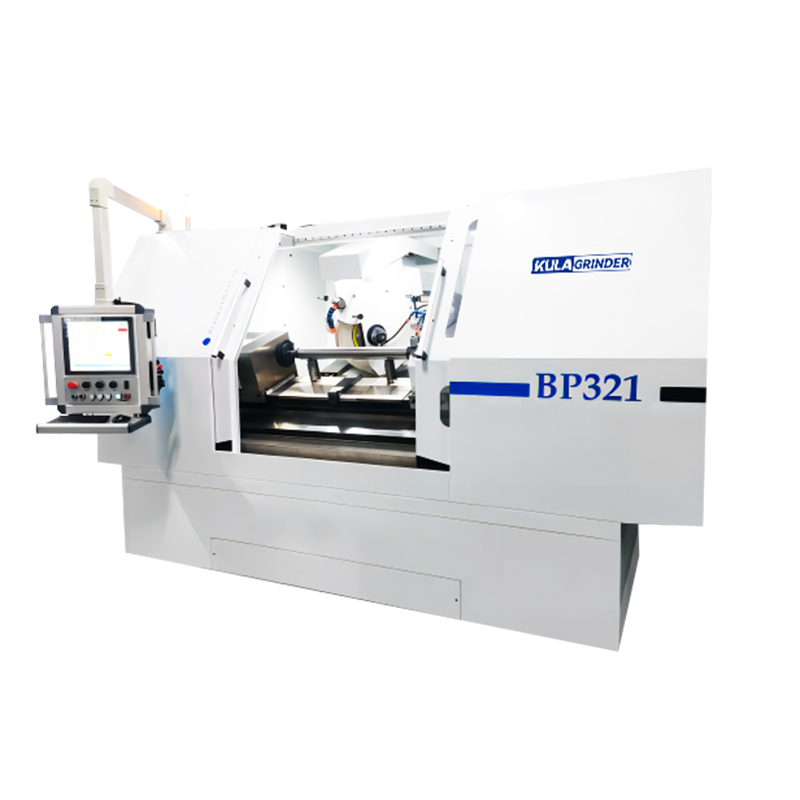
Design Features That Make a Combined OD and ID Grinding Machine Ideal for Small Parts
Machine design determines real-world accuracy and uptime. For small components, structural details matter more than marketing phrases.
Compact machine architecture and thermally stable base design
To hit micron-level tolerances, the force loop must be short and rigid. A good Combined OD and ID grinding machine often includes:
A monolithic, thermally stable base, often cast iron or mineral cast.
Short, direct mounting between wheelhead, workhead, and tailstock.
Symmetrical structure that reduces thermal bending.
These features reduce drift over long shifts. They also make the machine more tolerant of ambient temperature changes.
High-speed cartridge-style ID spindles and interchangeable OD wheelheads
Small bores require small wheels. Small wheels need higher speeds to generate proper cutting speed. The ID spindle must therefore run fast and stay stiff.
Modern machines often use:
Cartridge-style ID spindles for quick swaps and maintenance.
Motorized OD spindles, dynamically balanced for high rpm.
Interchangeable wheelheads for different part families.
On a CNC Composite Grinder, these elements support ID, OD, and sometimes thread grinding on the same platform. This gives you flexibility as product mixes evolve.
Precision workholding for miniature components
Workholding is not an afterthought. For small parts, it becomes the heart of the system. Common solutions include:
High-precision collet chucks.
Hydraulic or air chucks for delicate parts.
Micro-jaw or diaphragm chucks for thin-wall rings.
Good workholding reduces runout and protects parts from deformation during clamping. This is critical for small medical, hydraulic, and fuel-system components.
Intelligent coolant and chip management for tiny geometries
Fine wheels and tiny features clog easily. Poor coolant management increases heat and damages surfaces. An ideal machine uses:
Nozzles that direct coolant right into the grinding zone.
Filtration that removes fine swarf before it recirculates.
Coolant temperature control to stabilize part and machine.
These details extend wheel life and keep surface finishes consistent over long runs.
Process Advantages: From Single Clamping to Complete Small-Part Grinding
Once the hardware is in place, process design delivers the real payoff. A Combined OD and ID grinding machine can transform daily production metrics.
Eliminating multiple setups and part transfers
Each time you unclamp a part, you break the datum chain. You also add risk: dropping, misclamping, or mixing parts.
Single clamping reduces:
Number of setups per part.
Handling time and operator touches.
Opportunities for human error.
It also simplifies scheduling. One machine completes more of the process. You track fewer WIP queues across the shop.
Improving cycle time with combined OD and ID grinding
Cycle time includes cutting plus all non-cutting activity. A combined OD/ID approach reduces:
Many shops see double-digit cycle-time reductions after optimization. For example, a part once needing three machines may move to a single combined cycle that cuts total time by 20–40% (values should be validated on site).
Enhancing quality: concentricity, coaxiality, and form accuracy
Quality in small parts often means controlling relationships, not only individual dimensions. Key metrics include:
Concentricity between outer diameter and bore.
Coaxiality of multiple diameters and shoulders.
Flatness and perpendicularity of faces.
Grinding all these features in one clamping keeps the datums related. It becomes easier to maintain geometric tolerances within a narrow band across large batches.
Reducing scrap and rework in high-precision small-part production
Fewer setups reduce the number of times a part can be damaged. You also reduce variation between operations.
A typical “before vs after” comparison might look like this (example values only):
| Metric | Separate OD + ID | Combined OD/ID |
| Setups per part | 3 | 1 |
| Average cycle time per part | 10 min | 7 min |
| Scrap rate on critical parts | 4% | 1.5% |
These improvements flow straight to profit. They also free engineers to focus on new products instead of constant firefighting.
Key Applications for Combined OD and ID Grinding Machines in Small Components
Not every part justifies a combined machine. However, several small-component families gain strong, repeatable benefits.
Bearing rings, bushings, and sleeves with tight OD/ID relationships
Bearings and bushings demand precise alignment between raceways, bores, and outer diameters. One clamping lets you:
This reduces misalignment between raceways. It also supports quieter, longer-lasting bearings for high-speed or high-load systems.
Medical and dental components with micro bores and thin-wall sections
Implant parts, dental tools, and surgical instruments often include:
Tiny bores.
Very thin walls.
Complex transitions.
A Combined OD and ID grinding machine helps because it minimizes forces during repositioning. You avoid bending or scratching delicate features. You also reduce contamination risk from extra handling.
Precision hydraulic, pneumatic, and fuel system components
Hydraulic and fuel parts rely on tight clearances. Valves, sleeves, needles, and nozzles need matched OD/ID fits.
Grinding all critical diameters on a single machine supports:
Stable leakage performance.
Predictable flow characteristics.
Longer service life in harsh duty cycles.
Miniature shafts, spindles, and motor components
Miniature shafts and rotors often have multiple steps, tapers, and locating faces. A combined machine can:
Grind OD steps, journals, and shoulders.
Grind ID features for bearings or fasteners.
Maintain strict coaxiality between all features.
This supports quieter motors, smoother rotation, and better energy efficiency.
Automation, Software, and In-Process Measurement on Combined OD/ID Grinders
Hardware alone does not guarantee performance. Automation and software close the loop between planning and reality.
Robot loading and unloading for small components
Small parts are difficult to load by hand with consistent speed and care. Vision systems and robots help a lot:
Robots pick parts from trays, pallets, or rotary feeders.
Custom grippers handle delicate surfaces gently.
Automated loading keeps cycle time consistent across shifts.
Probes and in-process gauges for closed-loop control
In-process measurement is a powerful ally on a combined machine. You can use:
Touch probes to verify positions and diameters.
In-process air gauges or contact gauges on key bores.
Automatic wear compensation based on live readings.
Grinding software and conversational programming for complex small parts
Modern controls include templates and cycles tailored for grinding. They simplify multi-step processes:
Pre-set cycles for plunge, traverse, and shoulder grinding.
User-friendly screens for tapers, threads, and faces.
Conversational interfaces that reduce programming time for new parts.
Connectivity, data logging, and OEE monitoring
A connected grinder shares data instead of hiding it. You can log:
Part counts and scrap events.
Dressing cycles and wheel usage.
Machine alarms and downtime reasons.
Setting Up a Combined OD and ID Grinding Machine for Small Components
Good setup practice turns potential into repeatable performance. Many problems come from rushed implementation, not from the machine itself.
Workholding and fixturing strategies for tiny and fragile parts
Start from the part, not from a catalog. Think carefully about:
Where you locate the part.
How clamping forces flow through the material.
How much surface you grip and at which position.
Use light, uniform clamping for thin walls. Consider soft jaws, collet sleeves, or diaphragm chucks for fragile components. Always verify runout before full production.
Choosing grinding wheels and dressing strategies for miniature features
Small parts need fine control of wheel behavior. When selecting wheels, consider:
Abrasive type for the material, such as corundum or CBN.
Grit size to balance stock removal and surface finish.
Bond type and hardness for wheel stability.
Dressing strategy then shapes performance. Use:
Frequent light dressing for consistent cutting action.
Profile dressers for complex shapes.
Separate dressing programs for OD and ID wheels, tuned to each family.
Managing thermal stability and coolant parameters
Thermal behavior can make or break micron-level grinding. Key practices include:
Warm-up cycles before critical production.
Stable coolant temperature, close to shop ambient.
Filters that keep fine swarf away from sensitive areas.
Programming safe and efficient paths for short cycle times
Safety and productivity must balance each other. Effective programs:
Use clear approach and retract paths for each wheel.
Avoid unnecessary axis motion between operations.
Include spark-out passes for size and finish stability.
Simulate motions on the control whenever possible. For complex CNC Composite Grinder paths, digital twins or offline simulation tools add extra safety and reduce commissioning time.
How to Select the Right Combined OD and ID Grinding Machine for Your Small-Part Production
Choosing a machine is a strategic decision. It should follow clear technical and financial logic, not only price.
Matching machine capability to part size, tolerance, and material
Start by mapping your actual parts. Capture:
Smallest bore and tightest ID tolerance.
Largest OD and longest part length.
Hardest material and toughest surface requirement.
Then check each candidate Combined OD and ID grinding machine against that list. If a machine cannot handle your extremes, it may create future bottlenecks.
Conclusion
A Combined OD and ID grinding machine for small components reshapes precision grinding strategy, not just equipment investment. Merging OD and ID in one clamping improves concentricity, reduces setups and handling, and stabilizes quality over long runs. Very large or highly specialized parts may still require dedicated grinders, so many plants adopt balanced hybrid grinding layouts. KULA supports this shift with Combined OD and ID grinding machine lines and CNC Composite Grinder cells that boost profitability.
FAQ
Q: What is a Combined OD and ID grinding machine for small components?
A: A Combined OD and ID grinding machine grinds bores, outer diameters, and faces in one clamping for tighter, faster small-part production.
Q: What advantages does a Combined OD and ID grinding machine offer versus separate grinders?
A: A Combined OD and ID grinding machine reduces setups, handling, and tolerance stack-up, improving concentricity, cycle time, and scrap rates.
Q: How does a CNC Composite Grinder help on complex small parts?
A: A CNC Composite Grinder combines OD, ID, and extra operations in one platform, similar to a Combined OD and ID grinding machine for multi-surface parts.


