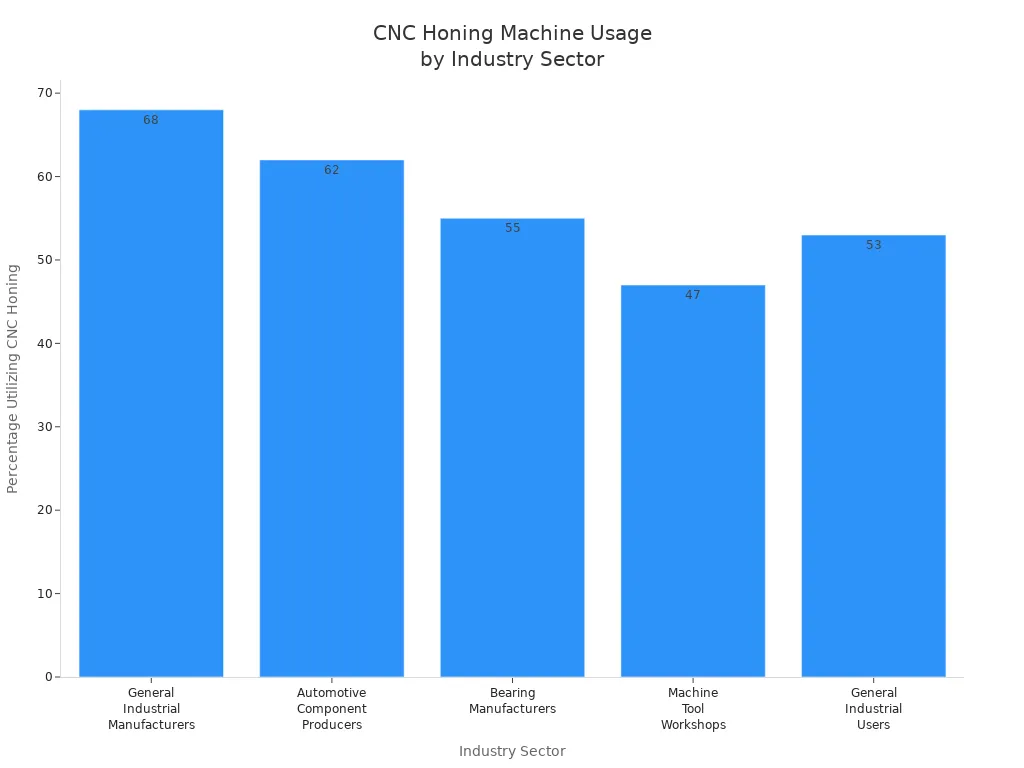
You want your parts to last longer. You also want them to work better. CNC Honing Machines help you reach these goals. They give you perfect holes and smooth surfaces every time. More than 60% of car and factory companies use this advanced technology. They use it for the best results.
KULA Precision Machinery Co., Ltd. is a leader in this field. They make smart designs and reliable machines. These machines make your job easier. They also make your products stronger.
Key Takeaways
CNC Honing Machines make metal holes smooth and exact. This helps parts work better and last longer.
There are five main types of CNC Honing Machines. Each type is good for a different job. The types are horizontal, vertical, single pass, multi-spindle, and CNC honing centers.
CNC technology helps stop mistakes made by people. It makes parts more accurate. It also makes sure every part is the same.
CNC Honing Machines help people work faster by using machines to do the work. This means more parts are made quickly and less material is wasted.
Many industries use CNC honing, like cars, planes, and medical devices. These machines help make strong, high-quality parts that follow tough rules.
What Are CNC Honing Machines?
Definition and Function
You might wonder what CNC Honing Machines actually do. These machines help you create smooth, round holes inside metal parts. They use special abrasive stones that rub against the inside of a hole. This rubbing action removes tiny bits of material. You get a perfect finish and the exact size you need.
The process works like this:
Step | Description |
1 | You mount the workpiece securely. |
2 | The CNC system moves the honing tool into position. |
3 | Abrasive stones spin and move back and forth, cutting away small amounts of material. |
4 | Coolant flows in to keep things cool and clean. |
5 | The machine stops when the hole reaches the right size and finish. |
CNC Honing Machines use abrasive tools to improve the surface finish of cylindrical bores. They help you achieve tight tolerances and smooth surfaces. The friction between the abrasive stones and the metal is what makes the magic happen. This process is key for parts that need to last a long time and work smoothly.
CNC Technology in Honing
When you use CNC technology, you get even better results. CNC stands for Computer Numerical Control. This means the machine follows a program, not just your hands. You set the instructions, and the machine does the rest. This reduces mistakes and gives you the same great result every time.
Here are some reasons why CNC Honing Machines stand out:
They use programmed instructions, so you avoid human error.
You can reach super tight tolerances, sometimes as close as ±0.005 mm.
Every part comes out the same, which is important if you make lots of them.
In one real-world example, a car parts company saw a 12% boost in how accurately they could position parts. They also cut down on mistakes by almost 15%. You save time, reduce waste, and get better products. CNC Honing Machines help you work smarter, not harder.
Types of CNC Honing Machines
There are five main types of CNC Honing Machines. Each type helps with different jobs in factories. Let’s look at each one so you can pick what you need.
Horizontal Honing Machines
Horizontal honing machines have spindles that go sideways. This makes them flexible for many jobs. You can use them for different parts. You can change setups fast. If you want to work faster, you can run more than one machine at once. That means you finish more parts in less time.
Here are some things that make horizontal honing machines special:
Feature/Technology | Description |
Flexibility | Lets you handle many part types and change setups easily. |
Efficiency | Multiple machines can work together for faster production. |
Integrated Tech | Uses smart motors and software for better control. |
Precision Checking | Confirms bore size during honing for top accuracy. |
Complex Shapes | Can create tricky shapes with digital controls. |
Typical Use Cases | Great for car engine blocks and crank bores. |
The KULA HM Series is a good example. These horizontal CNC Honing Machines are easy to use. They are great for small parts that need to be very accurate.
Vertical Honing Machines
Vertical honing machines stand upright. The spindle points up and down. These machines are used when you need a smooth finish and exact size. They are good for making lots of parts that all match.
Let’s see the good and bad sides:
Advantages | Limitations |
Improved Surface Finish | Longer Processing Time |
Precision and Accuracy | Limited Material Removal |
Versatility and Flexibility | Needs Skilled Operators |
Reduced Friction and Wear | Equipment Costs |
Consistency and Reproducibility | Size Limitations |
The KULA MB Series is a vertical CNC Honing Machine. It gives you great bore quality. It is simple to use, even if you are new.
Single Pass Honing Machines
Single pass honing machines finish the job in one step. The tool goes through the hole only once. This is best for making lots of straight holes fast. You see these machines used for gears, rocker arms, and gun barrels.
Here is how single pass compares to multi-pass:
Feature | Single-Pass Honing | Multi-Pass Honing |
Tool Design | Fixed size mandrels | Smart, adjustable tooling |
Surface Finish | Helical texture | Crosshatch pattern |
Flexibility | Limited part shapes | Handles many shapes and materials |
Material Compatibility | Cast iron, powder metals | Wide range of materials |
Application Suitability | Simple, straight bores | Complex and varied geometries |
Single pass honing is best if you want speed and repeatable results for simple parts.
Multi-Spindle Honing Machines
Multi-spindle honing machines work on many parts at once. Each spindle holds a tool. You can finish several holes in one cycle. This is great for big jobs. Factories use these machines for car parts, hydraulic fittings, and electrical connectors.
Here are places where multi-spindle machines are used:
Industry | Typical Parts & Applications |
Fluid power & hydraulics | Fittings, unions, adaptors, hose ends |
Automotive & heavy equipment | Pins, shafts, bushings, sleeves |
Industrial hardware | Standoffs, inserts, couplings |
Electrical & connectors | Terminals, contact bodies, nuts |
HVAC & appliance | Nozzles, valve parts, manifolds |
Tip: Multi-spindle machines help you finish parts faster and save money. You also get steady quality, even when making lots of parts.
CNC Honing Centers
CNC Honing Centers are all-in-one machines. They have advanced controls and automation. They can do tough jobs and switch tools without stopping. If you need to hone deep holes, like in oil and gas parts, look at the KULA HMT Series. These deep hole CNC Honing Machines use special heads for accuracy and speed.
CNC Honing Centers help you solve hard factory problems. They let you automate work, make fewer mistakes, and keep your quality high.
If you want your shop to do better, CNC Honing Machines give you the right tool for every job. You can choose the type that fits your parts, how many you make, and your quality needs.
Applications
Automotive
CNC Honing Machines are used a lot in cars. Car makers use them for engine blocks and gears. These machines help make smooth cylinder bores. Smooth bores help engines run well and last longer. Honing makes sure parts fit together just right.
Honing technology is now automatic. This helps make engine and transmission parts faster. It also improves quality.
Common parts you can hone in cars:
Engine blocks
Connecting rods
Transmission gears
Aerospace
Safety is very important in aerospace. Every part must follow strict rules. CNC honing helps finish turbine blades and fuel systems. You get smooth surfaces and exact sizes each time.
You control size, roundness, and texture.
The process stays accurate for many parts.
This keeps planes safe and parts working longer.
Hydraulic & Pneumatic
Hydraulic and pneumatic systems need smooth cylinders. CNC honing helps get the right inner diameter and finish. This makes cylinders last longer and work better.
You reduce leaks and wear.
Machines run more reliably.
You spend less money on repairs.
Typical uses:
Hydraulic cylinders
Pneumatic valves
Medical Devices
Medical tools and implants must be very precise. You need smooth finishes and exact sizes. CNC honing gives you control over these things.
You can use materials that are safe for the body.
You meet strict quality rules.
Surgical tools and implants work as they should.
Key benefits:
Ultra-smooth surfaces
Exact dimensions
High safety standards
Precision Engineering
Precision engineering needs every detail to be correct. CNC honing machines help make gears and shafts with tight tolerances. You can use IoT and AI to watch machines and fix problems early.
Where you see it:
Automotive
Aerospace
Robotics
Here’s a quick look at where CNC honing makes a difference:
Industry | Common Applications |
Automotive | Engine blocks, gears, transmission parts |
Aerospace | Turbine blades, fuel systems, landing gear |
Hydraulic/Pneumatic | Cylinders, valves |
Medical Devices | Implants, surgical tools |
Precision Eng. | Gears, shafts, robotics |
Advantages of CNC Honing Machines
Precision & Consistency
You want every part to fit perfectly. CNC Honing Machines help you get there. These machines fix tiny flaws like taper and out-of-roundness. You get holes with exact size and shape. The cross-hatch pattern they create helps oil stick to the surface, so your parts last longer and run smoother. Industries like aerospace and automotive trust this process because it gives you tight tolerances and a great finish every time.
Efficiency & Productivity
You need to make more parts in less time. CNC Honing Machines let you do that. Here’s how they boost your output:
They keep every part the same, so you don’t waste time fixing mistakes.
You get faster cycles because the machine sets the best speed and pressure.
Automation means you can run the machine longer with less help.
You spend less time on each part and get more done in a day.
Surface Quality
Surface finish matters. With CNC Honing Machines, you can reach top industry standards. Check out these numbers:
Surface Quality Standard | Tolerance |
Ra 0.1 μm or better | ±0.002 mm |
You see this level of quality in cars, planes, and medical devices. That means your parts look better and work better.
Automation
You don’t want to stand by the machine all day. Automation makes your life easier. Features like servo-controlled systems and automatic corrections keep the process on track. The machine checks its own work and fixes small problems. You get fewer errors and don’t need an expert operator for every job.
Cost Savings
Saving money is always good. CNC Honing Machines help you cut costs in many ways:
Cost Savings Category | Percentage Reduction |
Labor Costs | 40% |
Scrap Rates | Up to 30% higher throughput |
You pay less for labor and throw away fewer bad parts. With KULA’s user-friendly design and factory-direct support, you also save on training and maintenance.
When you choose CNC Honing Machines, you get better parts, faster work, and more money in your pocket.
You’ve seen how CNC Honing Machines help you get perfect holes, smooth finishes, and top-quality parts. You can pick from five main types for jobs in cars, planes, medical tools, and more. Real-world results show faster production and fewer mistakes. With smart tech and automation, you save time and money. If you want reliable results and expert support, KULA can help you upgrade your shop for the future.
FAQ
What materials can CNC honing machines handle?
CNC honing machines work with many materials. You can use them on steel, cast iron, and aluminum. The machine can change to fit what you need.
How do I choose the right type of CNC honing machine?
Think about the size and shape of your parts. Also, think about how many parts you want to make. If you are not sure, ask a trusted supplier for help.
Do CNC honing machines need a lot of maintenance?
Here’s some good news! CNC honing machines only need simple care. Clean the machine often and check the abrasives. Follow the manual for best results. Regular checks help your machine work well.
Can I automate my production with CNC honing machines?
Yes! New CNC honing machines let you use automation. You can set up the machine to run without people. This saves time and helps you make more parts.