Precision CNC cylindrical grinding machines in the automotive manufacturing industry ensure that engine crankshafts and camshafts achieve micron-level tolerances through high-precision grinding, improving power transmission efficiency, dynamic balance, and fuel economy.

I. The Precision Requirements of the Automotive Industry for Crankshafts and Camshafts
The automotive industry's requirements for crankshaft precision include a diameter tolerance of at least IT6 for main journals and connecting rod journals, a cylindricity grade of 7 or higher, an external runout ≤0.08mm, and a coaxiality ≤0.1mm, to ensure dynamic balance and power transmission efficiency.
Camshafts require journal roundness errors ≤0.005-0.01mm, with contour accuracy controlled at the micron level, affecting valve opening and closing timing and lift; deviations can increase fuel consumption by more than 5%.
These stringent standards stem from the need for minimal vibration, excellent NVH performance, and durability during high-speed engine operation, with a surface roughness Ra below 0.63μm to support high compression ratio designs.
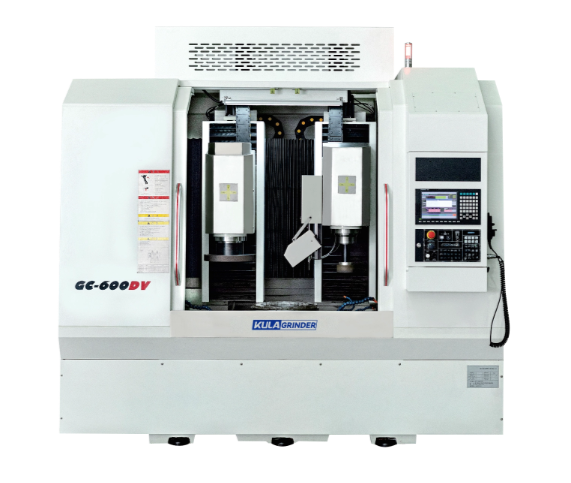
The most remarkable advantage of the KULA precision CNC cylindrical grinding machine is its exceptionally high machining accuracy. It easily achieves tolerance levels of IT5-IT6, with surface roughness as low as Ra0.1μm or even better. This means that workpieces ground by it have extremely small dimensional deviations and smooth, flat surfaces, requiring almost no additional finishing processes. It directly meets the stringent quality standards of critical components such as aerospace engine blade shafts, automotive gearbox gear shafts, and precision transmission rods in medical devices, helping these products perform at their best in their respective fields.
II. Structural Principle of the Precision CNC Cylindrical Grinding Machine
The precision CNC cylindrical grinding machine adopts a compact layout, mainly composed of a bed, grinding wheel head, worktable, headstock, tailstock, and CNC system, providing high-precision grinding. The bed, as the foundation, is welded from high-strength cast iron or steel and undergoes aging treatment to eliminate internal stress, ensuring stability under grinding forces. The grinding wheel head is mounted on a slide saddle, supporting transverse feed. A high-precision hydrostatic spindle drives the grinding wheel to rotate at high speed (thousands of revolutions per minute), with rotational error controlled within micrometers, achieving stable cutting. The worktable is driven by a servo motor and ball screw for longitudinal reciprocating motion, and integrates an automatic dressing device to maintain the sharpness of the grinding wheel.
The headstock uses a three-jaw self-centering chuck or a four-jaw chuck to hold the workpiece, and the tailstock adjusts the center axis to align with the grinding trajectory, ensuring coaxial accuracy. The CNC system acts as the "brain," precisely controlling the feed rate, depth, stroke, and coolant spray through programming, achieving automated multi-axis linkage and reducing human error. The working principle combines high-speed grinding wheel rotation (main motion) with workpiece rotation and longitudinal feed, while transverse feed cuts the outer diameter. It supports the machining of cylinders, conical surfaces, and steps, suitable for complex parts such as automotive crankshafts.
III. Machining Performance and Technical Advantages
1. High-Precision Machining Capability: The equipment achieves micrometer-level tolerance control, with a cylindricity error of <2μm, suitable for hard materials such as quenched alloy steel, requiring almost no subsequent finishing. CBN high-speed grinding (>60m/s) ensures dimensional stability and surface finish, supporting standards for critical engine components such as gearbox gear shafts.
2. High-Efficiency Production Advantages: Multi-stage, full-sequence grinding is completed in a single setup, reducing loading and unloading time and increasing single-machine efficiency by 3-5 times compared to traditional manual grinders. Automatic wheel compensation and intelligent fault diagnosis functions enable continuous operation, shortening downtime and adapting to high-volume order demands.
3. Flexibility and Adaptability: Different specifications and materials, such as stainless steel, ceramics, or brittle materials, can be processed simply by switching CNC programs and grinding wheels. The CNC system supports rapid task switching, improving the company's responsiveness to diverse market orders. Excellent static and dynamic stiffness minimizes machining deformation.
IV. Detailed Explanation of Automotive Crankshaft Machining Process
Crankshaft machining is divided into rough grinding, semi-finish grinding, and finish grinding. The main journal is first ground to semi-finish dimensions, followed by sequential grinding of the connecting rod journal, ensuring circular runout <3μm. The equipment utilizes CNC interpolation to achieve non-circular trajectories and automatically measures and compensates for wear. CBN grinding wheels achieve cutting speeds >60m/s, with a single machine producing hundreds of parts per day, and tolerances exceeding design values by 50%. KULA grinding machines integrate flexible fixtures, supporting switching between multiple vehicle models and improving engine balance and power output stability.
V. Camshaft Precision Grinding Applications
Camshaft grinding focuses on contour accuracy, with the CNC system generating a peach-shaped curve, a feed resolution of 0.1μm, and control of valve lift error <1μm. In non-circular grinding mode, the grinding wheel rotates synchronously with the workpiece, avoiding overcutting and supporting high-hardness cams such as those made of powder metallurgy materials. The machined surface is smooth, reducing lubrication requirements and directly lowering fuel consumption. This process ensures rapid engine response and is suitable for turbocharged and hybrid vehicles.
VI. Applications of Precision Cylindrical Grinding Machines in Other Industries
Precision cylindrical grinding machines are used in the aerospace field to process landing gear struts, rotor shafts, and turbine blades, ensuring dimensional accuracy <5μm and withstanding high loads and fatigue stresses. In mold manufacturing, it grinds slender shaft parts such as guide pillars and ejector pins, achieving strict dimensional consistency and a surface finish of Ra0.1μm, improving mold opening and closing smoothness and product qualification rate >99%. Electronic industry applications include micro-motor shafts and fiber optic connector cores, achieving a surface roughness of Ra0.05μm for diameters <3mm, supporting miniaturized high-performance products; the hydraulic component and bearing industries also rely on its precision machining to improve durability.
VII. Purchase Recommendations
When purchasing a precision CNC cylindrical grinder, consider four aspects: machining accuracy, CNC system flexibility, brand after-sales service, and overall cost. Ensure the equipment rigidity >100N/μm, supports CBN grinding wheels, and verify a test cut CpK >1.67 to match the high requirements of automotive crankshafts, etc.
Summary
Precision CNC cylindrical grinders, with their high-precision structure and automation performance, support the machining of automotive crankshafts and camshafts, ensuring micron-level tolerances and high-efficiency production. Their applications are widely expanding into aerospace, mold making, and other fields, driving the intelligent upgrading of the manufacturing industry.


