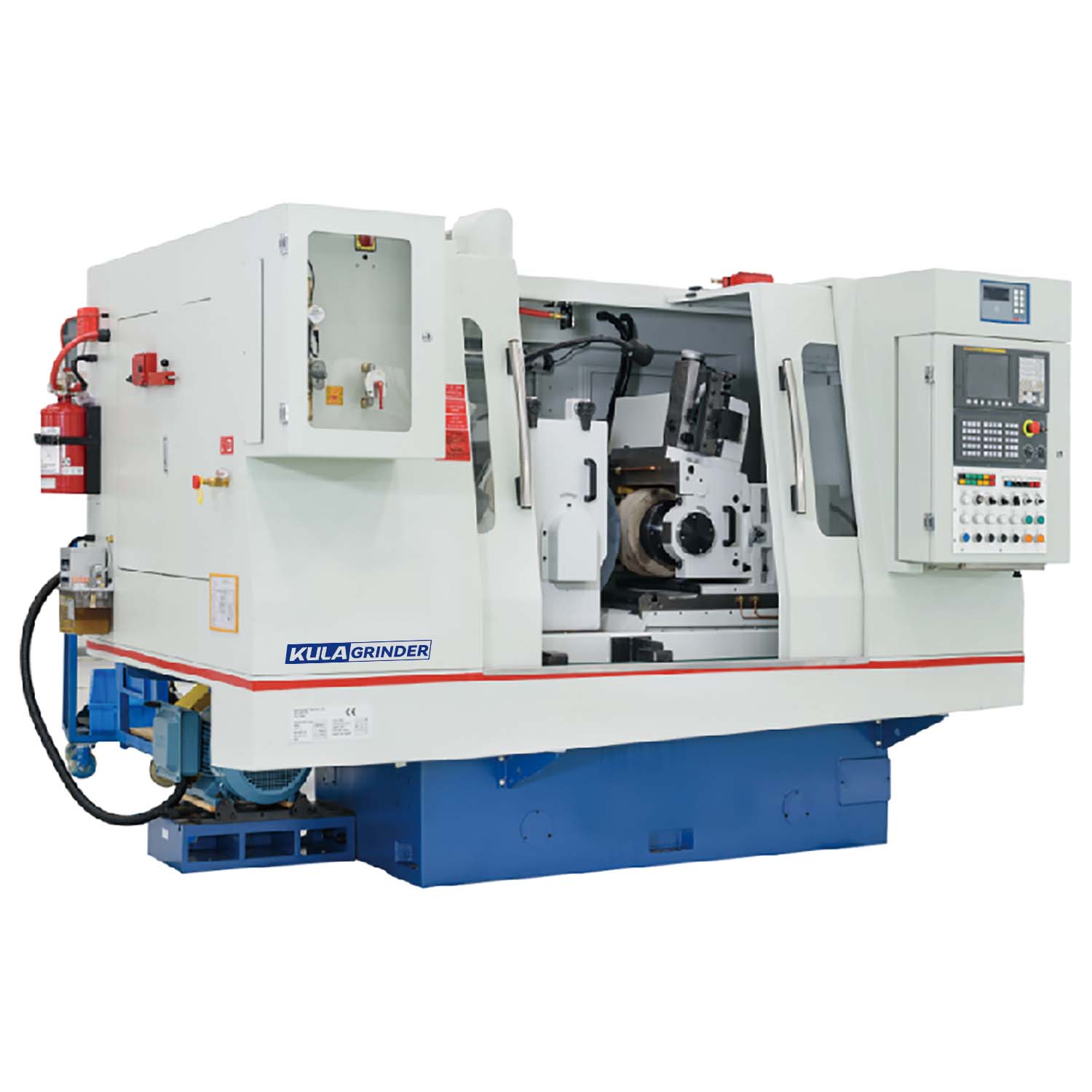
Job shops face a severe dual bottleneck today. A rapidly shrinking pool of highly skilled grinding operators struggles to meet rising customer demands. Industry data suggests 22% of these veteran machinists will retire by 2025. They take decades of vital tribal knowledge out the door. Meanwhile, clients expect tighter tolerances and faster lead times than ever before.
Traditional grinding relies heavily on manual loading, in-process gauging, and manual wheel dressing. This outdated approach restricts output strictly to an operator's physical presence and daily stamina. You cannot scale production when machines sit idle during breaks or shift changes.
Implementing targeted CNC grinding automation for job shops allows you to decouple production output from headcount entirely. By treating automation as a process multiplier rather than a simple labor replacement, you can achieve unattended production. This strategy ensures consistent quality and higher margins, even in complex, high-mix, low-volume manufacturing environments.
Key Takeaways
Automation in job shops is no longer restricted to high-volume production; modern flexible robotics and quick-change tooling allow for efficient high-mix runs.
Integrating in-cycle inspection and automatic wheel dressing drastically reduces the machine's reliance on manual operator interventions.
Choosing the right automation strategy requires aligning part families with specific machine types (e.g., centerless vs. cylindrical grinders).
Successful implementation relies on baselining current setup times, identifying an internal "automation champion," and phasing in technology to manage up-front costs and floor space.
The Business Case: Why Automate CNC Grinding in a High-Mix Environment?
Many job shop owners view automation as a tool reserved exclusively for massive production runs. This outdated mindset leaves massive profit potential on the table. High-mix environments actually benefit immensely from flexible automation. You simply need to shift your perspective on how operators interact with the equipment.
Decoupling Output from Headcount
The skilled labor shortage is an unavoidable reality. You cannot easily hire your way out of a backlog anymore. Automation addresses this gap directly. It shifts the operator's role from repetitive manual loading to cell management. One skilled machinist can oversee three or four automated cells simultaneously. They focus on optimizing programs, troubleshooting, and quality control. The robot handles the heavy lifting.
Eliminating Hidden Downtime
Manual processes introduce countless micro-stoppages throughout a shift. A human operator must wash parts, gauge diameters manually, and sometimes walk across the shop for tooling. These non-value-added seconds accumulate into hours of lost spindle time weekly. Any modern CNC Grinding Machine paired with robotic tending targets these precise inefficiencies. The machine keeps running while the robot handles the secondary tasks.
Unlocking "Lights-Out" Capacity
Financial returns transform dramatically when you capture unattended spindle hours. Imagine running a lightly-attended second shift or a completely unattended third shift. You do not pay premium overtime labor rates for these hours. Capturing just four extra hours of unattended grinding per day drastically shortens your equipment payback period. This newfound capacity allows you to bid on larger contracts confidently.
Quality and Scrap Reduction
Humans get tired. Fatigue leads to misaligned parts, skipped measurement intervals, and ultimately, scrapped material. Automated loading mechanisms and in-cycle probing eliminate this stacking of human errors. Robots load every single blank with identical pressure and positioning. This ensures absolute consistency across incredibly tight-tolerance grinding operations.
Best Practices for Building the Business Case
Track actual spindle run-time for one week before quoting an automation system.
Calculate the scrap cost generated during the last hour of long shifts.
Factor in the cost of unfulfilled orders due to capacity constraints.
Matching Automation Solutions to Your CNC Grinding Machine
You cannot buy a one-size-fits-all robot and expect immediate success. Successful automation requires framing the hardware directly around your specific grinding application. Different machine architectures demand entirely different material handling strategies.
Automating the CNC Centerless Grinder
A CNC Centerless Grinder thrives on continuous throughput. Plunge and through-feed operations require a steady stream of material to maximize efficiency.
For high-volume continuous runs, bowl feeders and vibratory tracks provide the most reliable material flow. They orient small cylindrical parts automatically and feed them directly into the regulating wheel. For larger or heavier shafts, automated gantry loaders work best. Gantries drop down from above, saving floor space while rapidly staging the next blank during the active grinding cycle.
Automating the CNC Cylindrical Grinder
Part handling flexibility becomes the primary focus here. A CNC Cylindrical Grinder often processes stepped, tapered, or varied-diameter parts. Loading these between centers requires dexterity.
Six-axis collaborative robots (cobots) excel in this environment. They mimic human wrist movements to maneuver complex geometries into tight work envelopes. Modular end-of-arm tooling is absolutely critical. You should utilize dual-gripper configurations. One gripper removes the finished part while the second gripper immediately inserts the raw blank. This cuts load times in half.
Internal Machine Automation (The "Hidden" Automation)
External robots only solve half the puzzle. To achieve true unattended operation, you must automate the internal variables. If a machine must stop for manual adjustments, the external robot sits idle.
Auto-Dressing
Dull wheels destroy part quality and increase cycle times. Utilizing Continuous Dress Creep Feed (CDCF) or overhead dressing mechanisms keeps wheels sharp constantly. These systems dress the wheel and control temperatures without ever pausing production. The CNC control automatically compensates for the reduced wheel diameter.
In-Machine Measurement
Advanced probing systems dynamically adjust offsets during the cycle. They replace manual micrometer checks entirely. The probe measures the part before the final finishing pass, updates the wear offset, and guarantees the part hits the tolerance band. This prevents out-of-tolerance parts from ruining an unattended run.
Common Mistakes in Machine Selection
Ignoring the coolant system. Unattended grinding requires high-pressure coolant and automated chip conveyors to prevent sludge buildup.
Buying a robot before verifying the machine's software can communicate via modern protocols like MTConnect or OPC-UA.
Overcoming Job Shop Implementation Risks and Flexibility Concerns
Job shop owners naturally resist rigid systems. You survive by pivoting quickly between different customer orders. The idea of bolting a permanent robot to the floor feels counterintuitive. However, modern automation specifically addresses these flexibility concerns.
Risk 1: The "Setup Time" Trap (Losing Flexibility)
Shop managers fear automation will take too long to change over between small batches. If a robot takes four hours to program for a 20-part run, you lose money.
You mitigate this by adopting Single-Minute Exchange of Dies (SMED) principles. Pre-stage your materials on mobile pallets. Utilize quick-change pneumatic robot grippers. Most importantly, group your parts into "families" sharing similar geometries. When parts share similar diameters, you rarely need to change the gripper jaws or the main robot trajectory.
Risk 2: Floor Space Limitations
Traditional enclosed industrial robots are bulky. They require massive safety fences. They disrupt forklift traffic and restrict material flow across the shop floor.
You must audit your physical shop environment before making a purchase. Opt for space-saving automated pallet pools or machine-mounted robots. Mobile cobot carts offer incredible flexibility. You can wheel a cobot up to a grinder, lock it into floor locators, and run a batch. When finished, you wheel it over to a CNC lathe. This maximizes your asset utilization while maintaining a minimal footprint.
Risk 3: The Operator Skills Gap
Many owners worry their current staff cannot program complex robotics. They fear they will need to hire an expensive robotics engineer just to keep the cell running.
Modern automation leverages conversational Human-Machine Interfaces (HMIs). Operators do not write raw code. They use drag-and-drop touchscreen icons to teach the robot waypoints. You must upskill your current workers by framing automation as an enabling tool. Show them it enhances their job security and technical value. It removes the dirty, dull, and dangerous tasks from their daily routine.
Summary of Automation Risks and Mitigations
Perceived Risk
Traditional Scenario
Modern Mitigation Strategy
Lengthy Changeovers
Hours spent re-teaching robot paths and changing hard jaws.
Group parts into families; use quick-change modular grippers.
Floor Space Loss
Large safety fences blocking shop aisles.
Deploy mobile cobot carts or top-mounted gantry systems.
Programming Complexity
Requires specialized G-code or proprietary robot programming.
Use conversational HMIs and drag-and-drop visual software.
Process Inconsistencies
Relying on manual mid-batch offset adjustments.
Implement in-machine probing for automatic wear compensation.
A Decision Framework for Evaluating Automation Investments
Jumping into automation without a roadmap guarantees frustration. You need a structured approach to evaluate where capital will yield the highest return. Follow this progressive framework to ensure a successful deployment.
1. Baseline Your Current OEE (Overall Equipment Effectiveness)
Before quoting a system, you must measure current spindle utilization accurately. Categorize your existing downtime meticulously. How much time goes to setup? How much to manual loading? How much to inspection? If your grinder only cuts metal 25% of the shift, you have a prime candidate for automation. You cannot improve metrics you do not measure.
2. Identify Part Families, Not Just High-Volume Outliers
Assess your entire product mix strategically. Do not just look for one part you make 10,000 times a year. An ideal automation candidate is a family of parts sharing similar diameters and lengths. This allows the robot and grinder to process various distinct SKUs with minimal physical changeover. The software handles the variations while the hardware remains static.
3. Find Your Internal "Automation Champion"
Success requires strict internal ownership. Identify a technical lead inside your shop who is enthusiastic about process optimization. This person acts as the bridge between the shop floor operators, management, and the external equipment integrator. Without a dedicated champion, the new robotic cell will likely gather dust the moment a complex error code appears.
4. Verify Open Architecture and Support
Ensure the chosen automation integrates seamlessly with your existing legacy systems. Proprietary closed-loop systems trap you into expensive service contracts. Demand open architecture software. Additionally, verify all safety compliance standards. Your system must include built-in collision detection, integrated emergency stops, and proper safety scanning lasers if operating without physical fences.
Best Practices for Integration
Request a 3D simulation of the robotic cell from your integrator before signing the final purchase order.
Plan for a phased rollout. Automate one stable process first to build team confidence.
Ensure your chosen automation champion receives dedicated training time away from their normal production quotas.
Conclusion
Automation in job shops is no longer an experimental luxury. It acts as a required defense against severe labor shortages and continuously tightening profit margins. Expanding your capacity without adding extra operators gives you a formidable competitive edge in the modern manufacturing landscape.
You must set realistic expectations. True flexibility requires an upfront investment in process standardization. Remember, automation amplifies existing processes; it does not fix broken ones. If your grinding process is unstable manually, a robot will simply produce scrap metal faster.
Your immediate next step should be a thorough shop floor audit. Group your current production parts into logical families based on geometry. Then, consult with a specialized integration expert to map out a phased, high-ROI deployment strategy. Taking action today secures your production capacity for tomorrow.
FAQ
Q: Can a job shop automate small-batch grinding profitably?
A: Yes. By grouping similar parts into families and utilizing quick-change grippers and conversational programming, shops can efficiently automate runs as small as 20 to 50 pieces. The key is standardizing the physical workholding so that changeovers happen via software rather than mechanical adjustments.
Q: What is the typical footprint required for robotic machine tending?
A: While traditional enclosed industrial robots require substantial floor space, modern collaborative robots (cobots) are much more compact. They or integrated gantry systems can add automated tending capabilities in as little as 10 to 15 square feet of additional floor space.
Q: Does automation replace the need for an experienced grinding machinist?
A: No. It simply shifts their role. The fundamental physics of grinding—wheel selection, coolant application, speeds, and feeds—still require deep human expertise. Automation handles the repetitive execution. This allows the expert to oversee multiple machines simultaneously and focus heavily on programming and quality control.