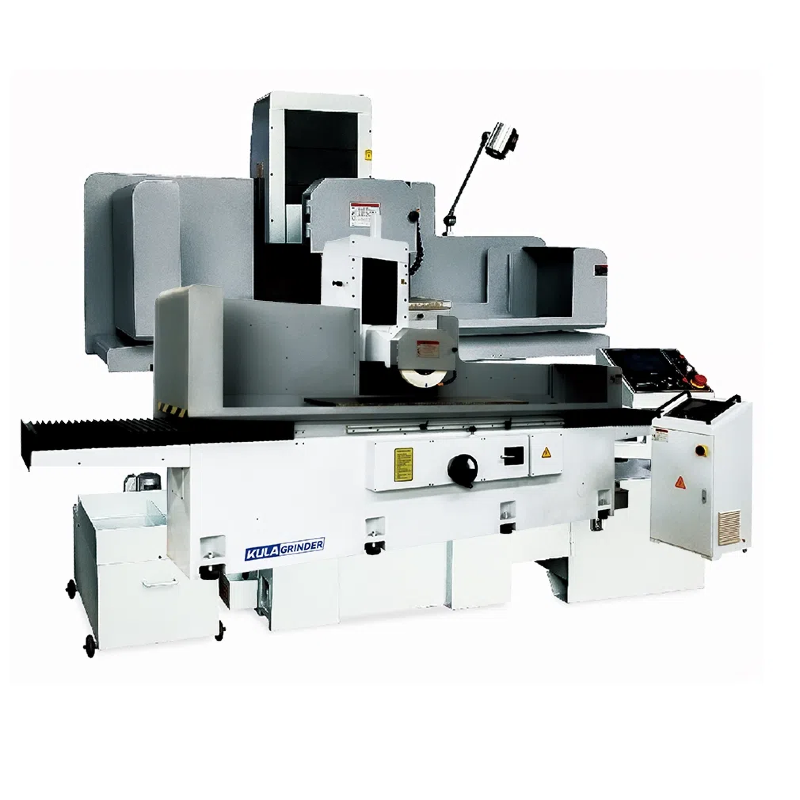
If your workshop is aiming to achieve faster throughput while keeping every part within tolerance, the CNC Surface Grinder is one of the most effective investments. Beyond its precision cutting, this machine integrates automation features—such as wheel dressing, dimension compensation, advanced fixturing, in-process inspection, and standardized programming—that directly reduce cycle time and improve process stability. At KULA Precision Machinery Co., Ltd., part of OTURN Machinery, we focus on solutions that allow manufacturers in industries such as aerospace, medical devices, and mold production to reach consistent high standards with every run.
Automate wheel dressing & dimension compensation
Grinding wheels gradually lose their geometry and sharpness during production. If not controlled, this leads to inconsistent surface finishes and wasted rework. A CNC Surface Grinder automates both wheel dressing and dimensional compensation, keeping production stable without slowing down operators.
How scheduled dressing stabilizes wheel geometry and surface finish
Manual dressing is not only time-consuming but also subject to variation between operators. With a CNC Saddle Surface Grinding Machine, wheel dressing can be scheduled at precise intervals. Each dressing pass restores the wheel’s cutting edges and ensures consistent contact with the workpiece. This maintains surface roughness within tight limits and prevents quality issues that would otherwise appear late in the batch. In large-scale production, automatic dressing can save hours of downtime every week, while also extending wheel life through consistent maintenance.
Setting dressing intervals and using compensation tables
The CNC system enables users to program dressing cycles based on part quantity or wheel wear sensors. Compensation tables further adjust offsets automatically, ensuring size accuracy without operator judgment calls. Over the course of a production shift, this approach eliminates cumulative error and avoids downtime caused by unexpected tool changes. Manufacturers who implement these functions often report both a higher first-pass yield and a smoother production rhythm, as operators can focus on overseeing the process instead of making constant manual corrections.
Smart fixturing for multi-part loading
Reducing idle time between cycles is one of the fastest ways to gain efficiency. Fixturing directly affects how many components can be processed per cycle and how easily operators can set them up.
Magnetic chucks, vacuum fixtures, and multi-part pallets for small parts
For flat workpieces, magnetic chucks remain the most reliable solution, holding components securely without complex clamps. When dealing with non-magnetic materials, vacuum fixtures or custom pallets are effective for batch loading. By using an Economic Saddle Surface Grinder with multi-part setups, manufacturers can run several components in one cycle, minimizing operator touches and spreading machine time over more output. This strategy is especially valuable in electronics and precision tooling, where small parts often need grinding in large volumes.
Tips to reduce loading/unloading time and clamp distortion
Quick-release pallets and repeatable locating systems shorten loading time dramatically. At the same time, avoiding over-tightened clamps reduces distortion, which is critical when chasing micron-level tolerances. For companies producing high-precision molds or medical instruments, the difference between one or two microns can determine whether a component passes inspection. By standardizing fixture design and training operators to use it effectively, shops can minimize variation across shifts, directly translating into consistent cycle times and fewer rejected parts.
Wheel selection & form dressing for complex grooves
Surface grinding is not limited to flat planes. Many industries demand grooves, profiles, and intricate geometries, and tool selection plays a defining role in how efficiently those requirements are met.
Choosing bonded wheels vs superabrasives for groove, pitch and form profiles
Bonded wheels are cost-effective for general use but wear faster under demanding geometries. Superabrasive wheels, such as CBN and diamond, maintain form longer, making them ideal for repeated groove grinding or hard materials. A CNC column surface grinding machine equipped with superabrasives can run longer without redressing, cutting down total cycle time while preserving form accuracy. Although superabrasive wheels have a higher initial cost, they frequently deliver a lower cost per part due to their durability and reduced downtime.
Using DXF-driven form dressing to reproduce profile shapes reliably
Modern grinders allow DXF files to drive form dressing routines. This ensures that even complex profiles are reproduced consistently without relying on manual adjustments. For industries like mold manufacturing, where every groove must be identical, CNC form dressing eliminates trial-and-error and guarantees high repeatability across production runs. In addition, the digital connection between CAD design and grinding execution means that design changes can be implemented quickly, giving manufacturers a competitive advantage in responding to customer requirements.
In-process measurement & closed-loop feedback
Even the best grinding cycle benefits from verification. Waiting until final inspection to catch dimensional drift often means scrapping an entire batch. With in-process measurement, corrections happen during the cycle itself.
Probing, on-machine metrology, and automatic correction loops
CNC Surface Grinders can integrate touch probes and laser sensors to check dimensions in real time. Once measurements are taken, the machine compensates automatically, ensuring the next pass corrects deviations. Closed-loop feedback like this reduces operator dependency and minimizes scrap. For aerospace parts with tight tolerances or medical implants that must meet strict standards, this automation builds confidence in every component produced.
Logging data for SPC and continuous improvement
Measurement data can also be logged for statistical process control. Over time, manufacturers gain insights into process stability and can fine-tune cycles to further reduce variation. In industries such as aerospace and medical devices, where traceability is mandatory, digital logs from the CNC system become a built-in advantage. Beyond compliance, these data-driven insights support continuous improvement initiatives, helping companies lower costs and shorten lead times while maintaining customer confidence.
Programming, operator training, and standardized cycles
The machine is only as efficient as the programs and people supporting it. Establishing standardized cycles and training operators to run them ensures that cycle time reductions and consistency gains are sustainable.
Build a library of optimized cycles per part family
Rather than programming from scratch each time, companies can develop libraries of optimized cycles for part families. This reduces setup time, keeps parameters consistent, and allows new operators to run proven programs confidently. For repetitive production, such a library can save hours per week and ensure that even different production lines deliver identical results.
Training checklist to avoid operator-induced variation
Even with automation, operator input matters. Training checklists ensure that setup, wheel selection, and fixture loading are performed consistently. At KULA Precision Machinery, we see many customers improve first-pass yield simply by aligning operator practices with the automated strengths of their CNC Saddle Surface Grinding Machine. By reducing human-induced variation, companies protect their investment in advanced equipment and maximize output quality.
Conclusion
Cycle time reduction and process consistency are not the result of one big investment but rather five smaller levers working together: automated dressing and compensation, smart fixturing, optimized wheel selection, in-process feedback, and standardized programming. A CNC Surface Grinder combines all these capabilities into one platform, making it a powerful upgrade for any manufacturer facing tight deadlines and strict quality demands. At KULA Precision Machinery Co., Ltd., part of OTURN Machinery, we recommend starting with a pilot project—adding fixturing improvements, dressing schedules, and one in-process probe within a few weeks—to see measurable gains quickly. To learn more about our CNC surface grinding solutions, contact us today.


