

close
Choose Your Site
Global
Social Media
Views: 0 Author: Site Editor Publish Time: 2026-10-15 Origin: Site


Investing in precision grinding equipment requires balancing immediate production needs against long-term flexibility. Buyers often struggle to choose between a dedicated machine for internal diameters (ID), outside diameters (OD), or a hybrid solution. Choosing the wrong configuration risks severe bottlenecks on your shop floor. You might even compromise concentricity on high-value parts if the machine cannot handle specific geometric tolerances. We understand this procurement challenge. This article provides a structured, evidence-based framework for evaluating a dedicated internal grinder against a standard CNC Cylindrical Grinder. We will focus purely on production volume, part geometry, and technical implementation realities. You will learn exactly how to align machine capabilities with your specific manufacturing floor requirements. By the end, you can confidently specify the right grinding technology for your unique applications and avoid costly production delays.
Primary Function: CNC cylindrical grinders are inherently built for outside diameter (OD) work (shafts, axles), whereas CNC internal grinders are engineered for inside diameter (ID) precision (bearing rings, gear bores).
Spindle Dynamics: Internal grinding requires significantly higher spindle RPMs and specialized vibration dampening to compensate for smaller grinding wheels.
The Hybrid Compromise: Universal CNC cylindrical grinders can perform both ID and OD operations, but often introduce longer changeover times and slight compromises in high-volume rigidity.
Cost Implications: Tooling costs and workholding complexities generally make internal grinding operations more expensive and technically demanding to optimize than external cylindrical grinding.
Understanding the baseline engineering differences helps you make informed procurement decisions. We must strip away marketing jargon and look at how these machines fundamentally operate. Each machine type relies on distinct physics to remove material efficiently.
Engineers design a standard CNC Cylindrical Grinder primarily for external surface grinding. These robust machines excel at shaping the outside diameter of rotating workpieces. They rely heavily on "between-centers" workholding. This setup clamps the part between a headstock center and a tailstock center. It provides maximum rigidity along the entire axis of the workpiece. You can achieve aggressive material removal rates because the part remains exceptionally stable.
Furthermore, these machines utilize large-diameter grinding wheels. A large wheel maintains stable surface speeds. It provides a massive circumference of abrasive grains. This translates to efficient material removal and extended intervals between dressing cycles. The physics of OD grinding allow for massive wheelhead designs, absorbing vibration effortlessly.
Conversely, engineers design a dedicated CNC internal grinder strictly to finish internal bores. You might need to grind straight, tapered, or complex profiled bores. This requires an entirely different mechanical approach. The center of the part must remain highly accessible for the grinding quill to enter. Therefore, you cannot use standard between-centers workholding. Instead, you must rely on chucking, collet systems, or centerless shoe-type workholding.
The most significant mechanical difference lies in spindle dynamics. Internal grinders must use high-frequency, high-speed spindles. You need to achieve the necessary surface feet per minute (SFPM) using exceptionally small-diameter grinding wheels. A small wheel must spin exponentially faster to match the cutting speed of a large OD wheel. This creates unique engineering challenges regarding vibration and heat generation.

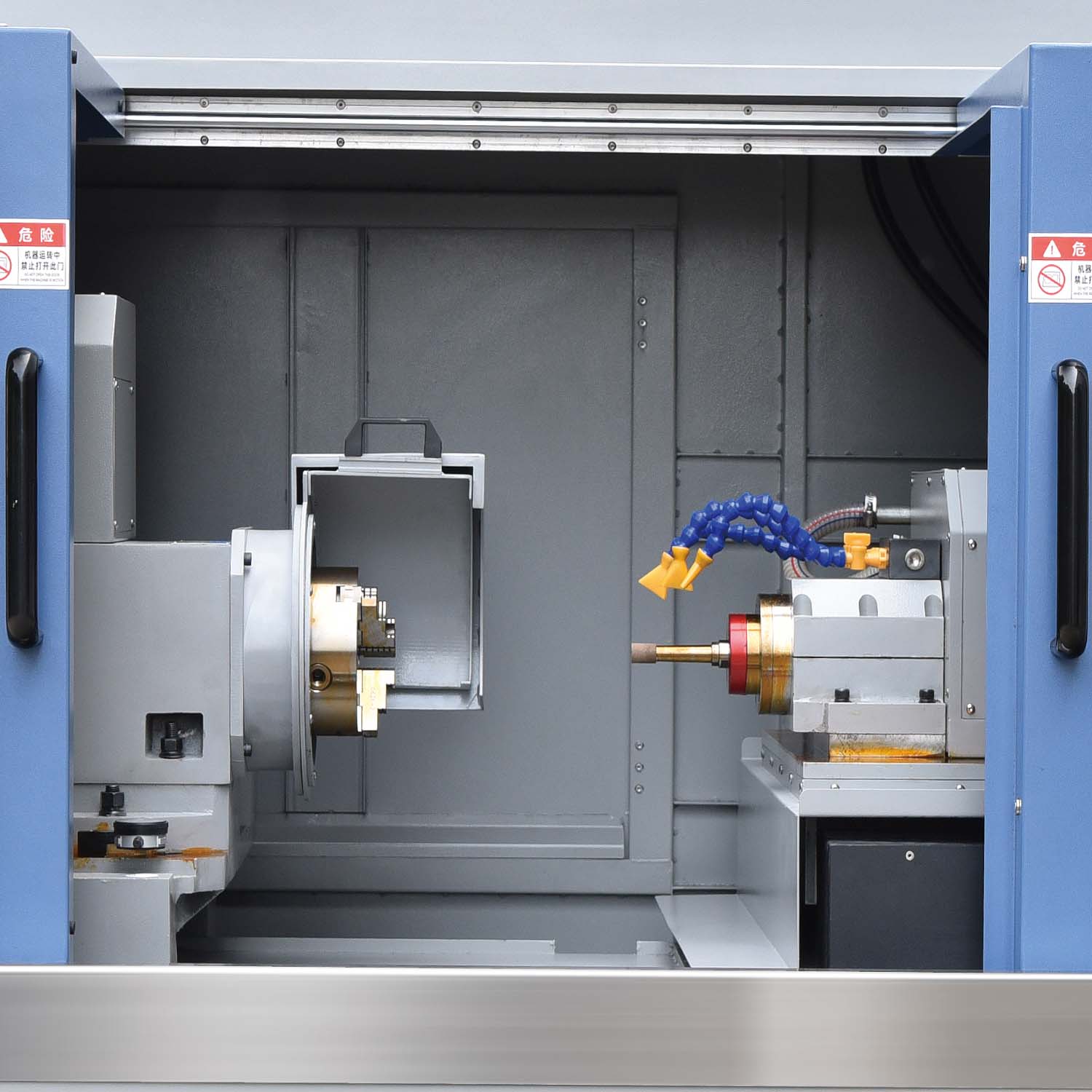
You must align your machine procurement directly with the geometry of the parts you manufacture. A mismatch here guarantees operational headaches. We categorize applications based on workpiece shape, volume, and required tolerances.
Part Characteristic | Recommended Machine Type | Primary Reason |
|---|---|---|
Long, slender shafts | Dedicated OD Grinder | Requires tailstock support to prevent bowing. |
Deep blind holes | Dedicated ID Grinder | Requires specialized quills and targeted coolant flushing. |
High-volume continuous step grinding | Dedicated OD Grinder | Large wheels allow single-plunge multi-diameter forming. |
Thin-walled bearing rings | Dedicated ID Grinder | Shoe-centerless workholding prevents part distortion. |
You should specify a dedicated CNC Cylindrical Grinder when manufacturing long, slender workpieces. Common examples include automotive driveshafts, aerospace actuator rods, and large print cylinders. These parts require robust tailstock pressure to prevent deflection during the grinding pass.
High-volume continuous production also demands a dedicated OD machine. Cycle time and rapid wheel dressing become paramount. Large wheels handle continuous heavy loads better than small internal wheels. Additionally, applications requiring multi-diameter external step grinding benefit greatly. You can dress a wide wheel with a complex profile, grinding multiple diameters in a single plunge.
You should specify a dedicated internal grinder for components demanding critical internal bore concentricity. Hydraulic sleeves, high-precision gear bores, and stator rings fall into this category. The straightness of the bore dictates the performance of the final assembly.
Deep-hole grinding applications absolutely require dedicated ID machines. These applications need specialized quill lengths. They also require advanced vibration-damped tooling, such as heavy metal or carbon fiber quills. Finally, asymmetrical or ring-shaped parts often render external grinding irrelevant. You might handle the OD in a completely separate turning operation, leaving only the bore for the grinder.
Procurement teams must assess specific technical dimensions before finalizing a specification. Looking beyond the brochure is essential. You need to evaluate rigidity, thermal management, and automation readiness.
Grinding forces naturally push the abrasive wheel away from the workpiece. Internal grinders face extreme cantilever forces. The grinding quill acts as a lever as it enters the workpiece. Even microscopic deflection causes tapered bores and poor surface finishes. You must evaluate the machine's specific dampening technology. Look for polymer concrete machine bases. They absorb vibration significantly better than traditional cast iron. You should also look for hydrostatic guideways to eliminate mechanical friction.
Conversely, you evaluate a standard CNC Cylindrical Grinder differently. You must assess tailstock pressure control. Precise programmable tailstocks prevent long parts from bowing under pressure. You also need to look at steady-rest integration. For particularly slender shafts, automatic steady-rests provide crucial mid-point support.
Spindle performance dictates grinding success. Internal grinding spindles operate under extreme conditions. They often exceed 60,000 to 120,000 RPM. This incredible speed generates massive amounts of heat. You must evaluate the integrated cooling systems. Precision liquid chillers are mandatory to prevent thermal growth. If the spindle expands from heat, your bore sizes will drift out of tolerance.
External grinders focus on entirely different spindle metrics. They prioritize high torque at lower RPMs. A massive 30-inch grinding wheel only needs to spin at 1,500 RPM to achieve optimal surface speeds. The focus shifts from extreme cooling to massive, ultra-rigid spindle bearings that handle heavy plunge forces.
Modern shop floors rely heavily on automation. You must assess how easily a machine integrates with robotics. Standard OD grinders are generally much easier to automate. You can use simple overhead gantry loaders. The gantry drops a shaft between the centers, the tailstock engages, and grinding begins. It is a highly repeatable, straightforward process.
Internal grinders present complex automation challenges. The robot must load a part into a chuck or collet. It requires precise robotic chucking. You must integrate part seating verification systems. If a gear blank sits slightly skewed in the chuck, the grinder will produce an eccentric bore. Pneumatic air-sensing switches often verify flat seating before the cycle starts.
Many buyers feel a strong impulse to buy one machine that does everything. The "Universal" grinder appears to solve all problems on paper. However, you must understand the practical trade-offs before committing to a hybrid approach.
A universal machine typically starts as a standard cylindrical grinder. Engineers equip it with a specialized swivel wheelhead (B-axis). This head features standard large wheels for OD work. It also features a drop-down or swing-down internal grinding spindle. The CNC control rotates the wheelhead to bring the correct spindle into the work envelope.
The primary advantage is process consolidation. You gain the ability to grind both the OD and the ID in a single clamping. This guarantees absolutely perfect concentricity between the bore and the outer surface. Once clamped, the part center axis never changes. For high-precision aerospace components, this single-setup approach proves invaluable.
Despite the flexibility, universal machines introduce specific operational risks. Changeover times interrupt your workflow. Switching from OD tooling to ID tooling, adjusting the coolant nozzles, and rotating the head takes time. This makes universal machines poorly suited for high-volume, low-mix production environments. They excel in high-mix, low-volume job shops.
Interference limitations also cause problems. The physical presence of both spindles on the same wheelhead consumes space. This can limit the maximum part swing. It can also limit the maximum part length you can process compared to a dedicated machine.
Finally, consider rigidity loss. Swivel heads inherently introduce micro-tolerances. Any rotating axis has a slight mechanical clearance. Highly dedicated, fixed-head machines do not have these micro-clearances. For ultra-heavy material removal, a fixed-head dedicated machine always outperforms a swivel-head universal machine.
Procuring the machine is only the first step. You must understand the long-term operational realities. Different grinding technologies demand different approaches to tooling, maintenance, and operator skill levels.
Abrasive wear rates differ drastically between processes. Internal grinding wheels wear significantly faster. They have a very small circumference. This means fewer abrasive grains do all the actual cutting work. Because each grain impacts the workpiece more frequently, the wheel breaks down quickly. You will require more frequent dressing cycles. You will also replace ID wheels much more often than OD wheels.
Standard OD grinder wheels last considerably longer. A large wheel distributes the cutting load across millions of grains. You might run hundreds of parts on an OD machine before needing a minor dress. This predictable wear rate stabilizes high-volume continuous production.
You must evaluate your workforce capabilities. Dedicated internal grinding often requires a higher degree of operator expertise. The operator must understand how to manage quill deflection actively. They must know how to program taper adjustments to counteract the bending of the internal tool.
Coolant delivery also requires advanced skill in ID grinding. Delivering high-pressure coolant into a deep blind hole is difficult. The operator must ensure chips flush out perfectly to prevent wheel loading. Standard external grinding is generally more forgiving. The wheel remains visible, and flooding the external contact zone with coolant is a straightforward process.
Selecting the correct precision grinding equipment dictates your manufacturing efficiency for decades. You must match the machine's fundamental engineering to your specific part geometry and production volume.
Assess your mix: If your production consists of 80% or more shafts and external profiles, a dedicated CNC Cylindrical Grinder is the absolute clear choice for maximum stability.
Evaluate flexibility needs: If you are a contract manufacturer dealing with high-mix, low-volume parts requiring both ID and OD work, carefully evaluate a Universal Cylindrical Grinder.
Identify bottlenecks: If you produce high volumes of gears, bearings, or precision sleeves, you must invest in a dedicated CNC internal grinder to maintain bore straightness.
Take action: Your next step is to request comprehensive time-studies from equipment OEMs. Provide actual part prints. Demand physical test-grinds to verify cycle times and tolerances before finalizing any machine specifications.
A: Yes, many OEMs offer aftermarket drop-down ID spindles. However, mechanical limitations exist. Retrofits often lack the extreme rigidity of factory-integrated systems. They can restrict your work envelope and introduce vibration. For light-duty or occasional ID work, retrofits succeed. For continuous precision bore grinding, a dedicated machine remains vastly superior.
A: No. A centerless grinder completely removes the need for centers or chucking. The part sits on a work blade between a grinding wheel and a regulating wheel. It is optimized for ultra-high-volume, single-diameter external grinding. A cylindrical grinder holds the part between centers or in a chuck, offering multi-step flexibility for complex profiles.
A: Internal grinding requires significantly higher coolant pressure. You must precisely target the fluid into restricted bores to flush swarf completely out of the hole. Poor flushing causes the small wheel to pack with chips, destroying the finish. External OD grinding generally relies on higher coolant volume rather than extreme pressure to flood the open cutting zone.


